Editor’s note: We welcome a guest blog post from Lexi Kadis, Teaching and Learning Librarian at the University of Maryland Libraries.
I was in a state of perpetual déjà vu throughout the Spring 2026 semester. Just a year ago, I was on the academic librarian job market—revising CVs, writing cover letters, interviewing (rinse and repeat)—and now, I was helping six Master of Library and Information Science (MLIS) graduate students navigate the job search process.
I work as the Teaching and Learning Librarian at University of Maryland Libraries where I am also a co-director of the Libraries’ Reference and Teaching Fellowship (RTF), a three-semester, scaffolded professional development program that prepares MLIS students to be academic librarians. Since its founding in 2015, the Fellowship has supported more than 50 Fellows and has a proven track record of helping students find jobs (I should know, as I am a 2025 RTF alumna myself!).
Over the past semester, I have learned that supporting MLIS students on the job market takes a great deal of time, energy, and emotional labor. While I am a part of a team of four librarians who mentor our Fellows, I understand that for many librarians, providing mentorship and guidance to graduate students is a siloed act of service to the profession. To that end, I wanted to share my experiences and perspectiveon how to provide effective and sustainable mentorship to MLIS students.
Don’t Be the Cure-All
I first want to acknowledge that many graduate students turn to their library supervisors and mentors for job search guidance because of a lack of support from MLIS programs. Many of our Fellows have noted that the coursework and infrastructure of their graduate program has not prepared them to apply for academic librarian positions. From knowing when to start applying to jobs to turning resumes into CVs to preparing for full day interviews with job presentations, the hidden curriculum of the academic library job process is not being taught in library science classes.
Given the deficit of structural support—something you may have experienced in your own MLIS program—it is easy to want to be a cure-all for your mentees. However, trying to provide all the solutions is not a sustainable model for mentorship, particularly when it comes to the job search process. Based on my own experience, it is important to clearly communicate to your graduate students the types of help you can provide and when they should seek support elsewhere. Even if their MLIS program does not have a robust job search support system, students may have access to a campus career center, for example, and you can direct them to these types of resources.
Synchronous Feedback is your Best Friend
Guiding MLIS students through the job search process is very time-consuming. Reviewing materials, practicing for interviews, and serving as references can quickly eat up your whole work week. That is why it is helpful to think of ways to reduce time spent on this aspect of mentorship. One of the best ways to save time is to provide synchronous feedback only for application materials (whether CVs, cover letters, job presentation slide decks, lesson plans, etc.). For our Fellowship, this typically looks like a 20-30 minute meeting where I meet with the Fellow to review their documents and to provide verbal feedback.
I have found that synchronous feedback has benefits for both mentors and graduate students. It takes significantly less time to read and comment on a cover letter in person or over Zoom as, compared to doing it asynchronously. Additionally, when providing live feedback, students get to ask you clarifying questions in real time. Our Fellows have also noted that synchronous feedback is more helpful because a mentor reading your cover letter mirrors a potential employer doing the same. Rather than receiving line by line edits, hearing someone’s gut reaction helps graduate students understand if a cover letter is written effectively and persuasively.
The Emotional and Invisible Labor of Mentorship
I want to conclude this post by recognizing the emotional labor that goes into mentoring MLIS graduate students. We all know that the job search process can be emotionally charged, especially in an increasingly competitive job market and an unstable world at large. Writing cover letters and preparing for interviews is a deeply personal and vulnerable process that can bring up questions of identity and various feelings. As mentors, we are not only helping students to navigate the job search, but also the emotional potholes that come along with it.
It is equally important to acknowledge that mentorship is often invisible labor. The guidance that library mentors provide to graduate students is invaluable but often overlooked or unseen as part of our professional portfolios. The lack of visibility contributes to the isolation of mentors from each other. Based on my work with a team of librarians to support our Fellows, I believe that mentorship is at its best when it is collaborative. We can become better mentors by learning from each other. I encourage everyone to share their ideas, advice, and resources for mentoring MLIS students within their networks and communities.
Lastly, I want to thank the librarians and LIS professionals who have mentored me over the course of my library science journey and education. I think mentorship is very much a pay-it-forward act of service, and I am very grateful to be able to be a mentor to current and future graduate students.
Editor’s note: We welcome a guest blog post from Michael C. Weisenburg, Director of the Irvin Department of Rare Books and Special Collections at the University of South Carolina Libraries.
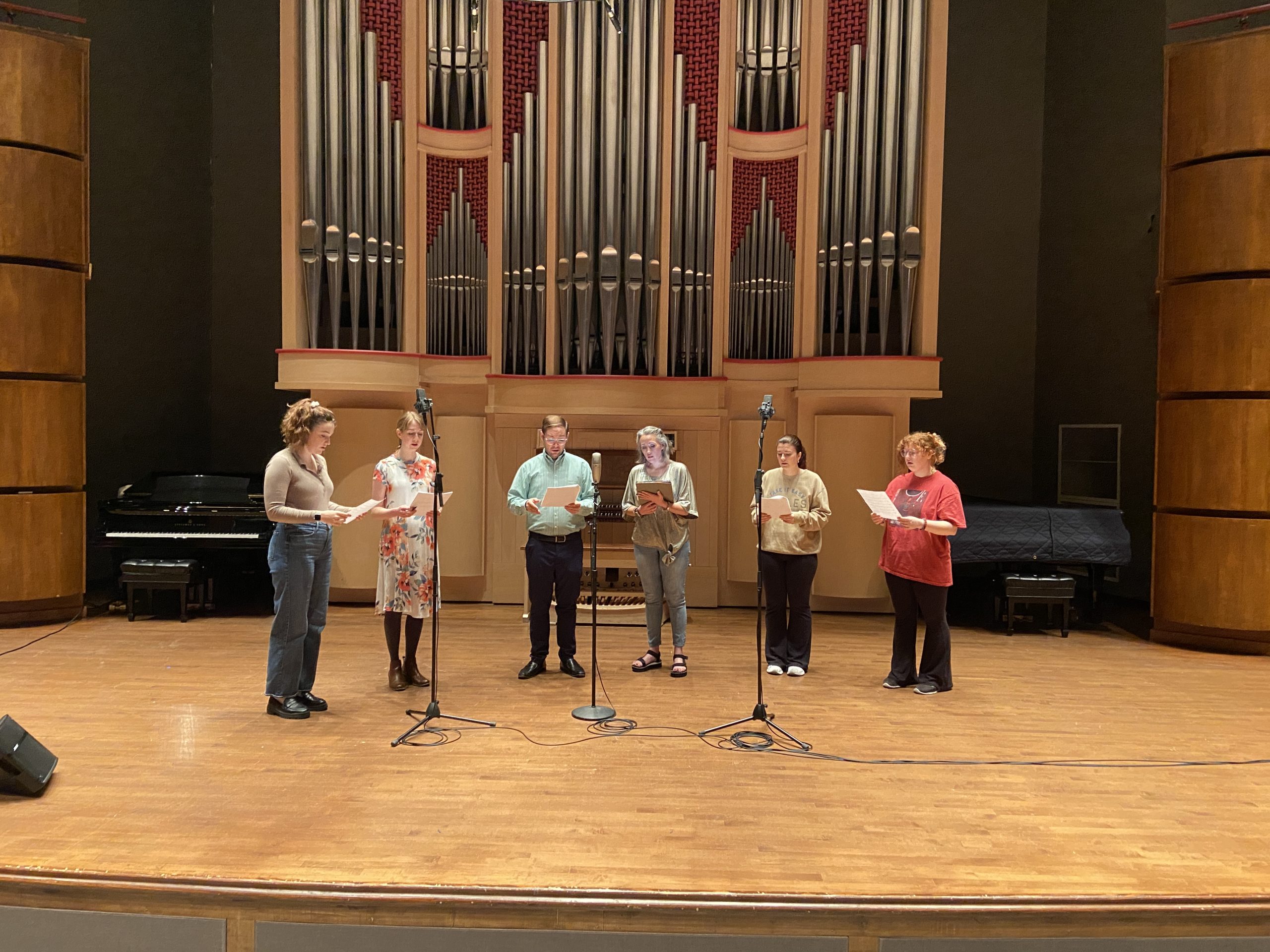
The first time I hosted our early music class in special collections in the fall semester of 2015, I approached the session the way many of us do: with a carefully chosen set of materials, a plan for introducing students to the history and significance of medieval manuscripts, and a hope that the students would leave with a sense of what special collections can offer. In this case, the materials were medieval plainchant manuscripts from our holdings. Many of them were fragments, a few were large codices, and one had even been cut up and turned into a lampshade at some point in the early twentieth century. They are visually striking objects, of course, but they are also something more than that. They were made to be used. More specifically, they were made to be sung.
That basic fact sat at the center of the session, even if I did not yet fully know what to do with it.
Like many instruction sessions in special collections, the visit began as an opportunity for hands-on engagement with the past. We talked about the manuscripts as artifacts, their material histories, how they were made and used, and how they are now used as historic evidence. We talked about what students could learn from seeing these items in person rather than through a surrogate. We also talked about the music itself. How plainchant written on vellum carried forward a traditional performative repertoire across centuries in forms that still invite interpretation. Eventually, a question emerged that shifted the project from a one-off class visit into something much larger: if these manuscripts were made to be sung, why not have students sing from them?
Photo courtesy of Sarah Williams, University of South Carolina School of Music
It was a question that kept coming up with every class visit, and eventually that question became Singing the Archives, a digital exhibit hosted by the University of South Carolina Libraries and developed through a collaboration among Rare Books and Special Collections, Digital Collections, and the School of Music. What began as recurring instruction sessions grew into a project that asked students not just to view manuscripts, but to work with them through transcription, research, performance, recording, and digital interpretation. The resulting exhibit makes those manuscripts more accessible, but it also does something else that feels especially important: it makes them audible.
One reason this project matters beyond our local context is that it challenged a familiar tendency in academic libraries to keep special collections in a silo. Even when we are committed to teaching with rare materials, it is easy for that work to remain bound by the reading room. A class comes in, students have a memorable experience, the session ends, and sometimes a few of them will come back to the reading room on their own to work with rare materials as primary source examples for a final project. There is nothing wrong with that model; it’s the bread and butter of special collections instruction; it is valuable and sufficient. But this project suggested another possibility. What if special collections instruction is not only an encounter, but the beginning of a collaborative process? What if the session becomes a point of departure for student research, creative practice, digital scholarship, and public-facing work?
That was the real shift. The project moved beyond a one-time instructional session and became a shared enterprise across departments and academic units and has been sustained over time. Students engaged with the manuscripts in different ways depending on their roles and expertise. Some worked on transcription and the challenge of rendering medieval notation into forms that modern performers could use. Others contributed contextual research, editorial work, and performance-practice inquiry. Many of them blogged about their experiences and the challenges the project presented. Library colleagues in digital collections developed the infrastructure through which that work could become legible and accessible to a broader audience. Faculty in music brought disciplinary depth, pedagogical continuity, and the willingness to let students learn by doing. The exhibit became not just a final product, but an on-going record of shared labor.
One of the most exciting things about the project is that it reframed access. In libraries, we often talk about access in terms of discovery, digitization, and online availability. Those are crucial forms of access, and this project certainly benefited from them. But Singing the Archives reminded me that access can also be interpretive and sensory. A digitized manuscript image may allow a user to see a page, but a performance and recording can help users understand what that page was for. In that sense, the exhibit does more than reproduce objects online. It mediates between artifact and experience. It helps bridge the distance between modern audiences and historical materials by showing that these manuscripts are not static relics but living components of musical and devotional practice.
I also think the project offers a useful model for academic librarianship more broadly because it shows what can happen when rare books instruction sessions are treated as a springboard rather than an endpoint. Special collections are sometimes described as treasures, and while that language is understandable, it can also be limiting. Treasure implies rarity, value, and protection. It does not always imply use or engagement. What’s compelling in this collaboration was the way rare materials became a meeting point for teaching, research, technical expertise, and public engagement. The manuscripts became prompts for interdisciplinary learning and relationship-building across campus. Additionally, the manuscripts became even more fun. There was something exciting about hearing students sing from the manuscripts and sharing in their utter glee at being allowed to do so.
Photo courtesy of Kristine Hontz, University of South Carolina Libraries
That’s the larger lesson. Special collections can be one of the places where academic libraries demonstrate their fullest value not because we hold unique things, but because we can convene unique forms of collaboration around them. We can help translate specialized materials into formats and experiences that invite broader participation. And we can do all of that without flattening the complexity of the objects themselves. In fact, we can do so better by helping the objects to live again and fulfill their original purposes.
Of course, projects like this do not happen easily. They require time, trust, and a willingness to share ownership. They also require us to think differently about instruction. A successful class session is not always the end of the story. Sometimes it is the research and development stage for something larger. That “a-ha” moment of realizing that students should not only study the manuscripts but sing from them depended on recurring contact, on faculty partnership, and on being open to the idea that a special collections session might evolve into a collaborative project neither side fully anticipated at the start.
One takeaway I would offer other academic librarians is that when we teach with special collections, we should pay attention to what students and faculty want to do next. Their off-the-cuff questions and spontaneous ideas may point toward a deeper form of engagement than we originally planned. In our case, that next question led from the reading room to the recording room, and then into a digital exhibit that made the project public. That path will look different at other institutions, but the principle holds. Special collections do not have to function as niche destinations within the academic library. They can be active partners in teaching, discovery, and interdisciplinary collaboration. Sometimes that begins with a simple question in the classroom. And sometimes, if we are willing to follow it, that question can help us hear the collections differently.
Editor’s note: We welcome a guest blog post from Rebecca Kyser, Research and Instruction Librarian at Himmelfarb Health Sciences Library, The George Washington University.
Disclaimer: All opinions expressed in this post are the author’s own and do not represent her place of work.
As a medical librarian who specializes in medical misinformation and disinformation, I tend to have a healthy skepticism for cure-alls. So when I first heard about AI’s promises of automating workflows, eliminating repetitive tasks and curing disease, my first thought was to investigate exactly how true they were. It’s been around four years since then but I’ve emerged from this process to find myself firmly an AI skeptic, especially in regards to large language models (LLMs). And to my disappointment, I’ve found LLMs frequently cited as a solution to solve countless problems of medicine.
With that in mind, I wanted to share some of my concerns about AI being integrated into medical technology. Not all of these issues are exclusive to medicine – many are found in any field that AI touches – but some of the consequences of AI behaving badly get far worse when people’s health is involved.
AI is Inaccurate
At this point, almost everyone has heard about AI hallucinations: instances where AI makes up false information. Hallucinations are baked in the technology: there is no way of getting rid of them entirely 1. Rates of false answers vary from model to model 2, and the rate is often published by independent assessors, rather than the companies themselves. The best response to this problem is to lower the rate as much as possible.
However, when we’re talking about wrong answers regarding medical information, what threshold of inaccuracy do we find acceptable? Hallucination rates of 39.6% 2may be acceptable when asking a bot about the weather, but would we consider that rate acceptable, or even a 10% hallucination rate, for a doctor prescribing you medicine? This isn’t to say humans don’t make medical errors – there’s plenty of scholarship on the topic and how to prevent it – but are their error rates comparable with a bot?
The error rate isn’t great at the moment. Multiple studies have shown chatbots make mistakes regarding medical queries: surgical errors leading to patient injury 3, undertriaging cases 4and providing faulty medical advice to the public 5. Those mistakes aren’t small outliers either: ChatGPT undertriaged cases 52% of the time 4and provided correct relevant conditions in less than 34.5% of cases5.
There is the argument that as AI gets better (which is an assumption worth investigating), this will cease to be an issue. However, even if AI had an accuracy rate equal or less than humans, another problem arises: who can be held liable for medical error when the error comes from a machine? Is it the person operating the machine or the person who built it? Without these kinds of clearly defined policies, addressing mistakes with AI in medicine becomes a thorny business.
Garbage in, Garbage Out
Most people know that LLM are trained off broad swaths of information online, but I don’t think we always consider exactly what that entails. Without having access to these models’ training data directly, we can only make educational guesses on what the training data entails, usually by looking at outputs and trying to reverse engineer their source. This is something I’ve done myself: if you have access to an AI that provides sources, ask it about a headline from Alex Jones’ infamous platform Infowars and watch it regurgitate it back to you.
A picture of a headline from Alex Jones Infowars website, showing Terminator-style robots with the headline “Humanoid Soldiers Tested in Ukraine; Founder Eyes Contract To Patrol US Border”
There is an argument this is remedied by ensuring the model only works off high quality training data. The problem is, we often don’t know exactly what was in the training data to begin with. Even if a model claims to be based on entirely scholarly sources, we should understand all the nuances of what that means: are all the sources peer-reviewed? Does the training set have safeguards against poor-quality sources from predatory publishers? Are retracted publications excluded from the training data? Is the data set monitored for works that are retracted after they enter the training data?
I think the best way to demonstrate this problem is to examine one of the few cases we’ve seen under the hood for a LLM: Claude. Due to a lawsuit, a database was published containing books Claude was trained off of, which the public can access.
One of the names that comes up in the training set is Graham Hancock. For those who don’t recognize the name, Graham Hancock is a pseudohistorian, who often argues that the work of ancient civilizations was actually built by aliens. His inclusion isn’t surprising – his work is incredibly popular and Claude debunks his theories if asked – but it does raise concerns about the training data for these models. Especially when there are more concerning inclusions, such as the work of Richard Lynn, who can also be found in the data set.
Richard Lynn was a well known scientific racist, known for promoting pro-eugenic ideas up until his death in 2023. Why is a scientific racist’s work fed into this model? If this model is being trained to answer questions, why does it have disproven scientific racism in it? You can’t argue its inclusion is due to popularity; unlike Hancock, only one of these publications is well known enough to even have its own Wikipedia page, and that page is mostly about its racist background 6.
I use Lynn as an example because of the history of scientific racism in medicine. Many medical AI attest to training only off medical publications or scholarly journals, but that does not mean those are free of false or harmful ideas. Lynn is an example of this: he published multiple works promoting scientific racism 7. How do we ensure this kind of work doesn’t end up in these models? And is anyone actually looking out for them?
Bias
Many people like to think machines aren’t biased, but that simply isn’t true. Machines are built by humans who contain a wide variety of biases, and those biases get filtered down into both our creations and the data we feed them. A really good example of this is from ProPublica’s investigation of recidivism calculators, which declared Black people at higher risk of offending than white people, even when the white person had a lengthier criminal record. 8
This is also an issue in medicine. One of the most common mistakes I see in these machines when it comes to medicine is anchoring bias: the bias to assume your first assumption is right. For example, when I asked an AI model for medicine for a differential diagnosis for a patient experiencing chest pain, it suggested cardiac causes. However, when I asked the same question but stated the patient had a history of anxiety, the differential shifted entirely to psychological causes.
What’s likely happening here has to do with the training data: these models are being fed on content like textbooks, case reports and other educational content. A classic case presentation often gives the reader the information they need to make a diagnosis but might leave out superfluous details that a patient might give in real life. Since the bot is unused to seeing those details outside of cases where they are important, it sometimes anchors on the wrong idea. This may explain why the accuracy rate fell so drastically when it came to doctors inputting information over patients: the doctors knew what information was clinically relevant, the patients did not. 5
No Free Lunch
While many LLMs are free to access at the moment, it seems unlikely that they will remain so. The power and processing power required to run these LLMs is significant and these companies are not non-profits. Which raises a question: how will these companies make money anyway? As the old economic saying goes, there is no free lunch.
Currently, that’s a question without an answer: OpenAI, the owner of ChatGPT, is still running at a loss and isn’t expected to turn a profit until 2029. 9 They have announced planned revenue streams involving integrating their product into their software (think of an LLM embedded into Word or another consumer product)10, but I want to focus on three potential answers to this revenue problem in particular.
The first revenue option is subscriptions: most AI companies already offer fee-based options such as early access to newer versions of the model or custom-built models with training data specified by the user. Which raises an issue common in subscription models: the cost of access. The inflationary costs of scholarly journals and publications have long posed a problem for library budgets; what happens when we add AI subscriptions to the mix? Will access to the latest AI models widen inequities in education?
Another likely answer to the revenue problem is advertisements. There is a long history of web platforms turning to advertisers to generate revenue when users are reluctant to pay for a service. This might seem more obnoxious than harmful, but the stakes when advertising medical interventions are much higher than those in marketing new shoes. Marketing to doctors fertilized the seeds of the Opioid Crisis, and we should consider the ramifications of Open Evidence- an AI platform that advertises itself to medical professionals- potentially advertising some drugs over others (this idea is explored fully in an excellent post from the Krafty Librarian)
We also have to consider a revenue stream most commonly used by social media sites: the sale of user data to advertisers. Of course, there is a hiccup here: individually identifiable health information is protected under HIPAA and cannot be disclosed. But that doesn’t mean data can’t be used if it is anonymized.
Let’s try an example. In this hypothetical, let’s say there’s a small town in Southern Colorado that suffers from a pollution issue that leads to interstitial respiratory disease. Medical professionals in the area are shown to ask one AI company queries regarding this condition and how to treat it at a higher rate than the rest of the country. The AI Company then sells this data, which while anonymized, shows this community suffers from this issue.
Here are some potential buyers:
A supplement company coming out with a tonic to soothe chronic cough. They place advertisements for this area around the symptoms of interstitial respiratory disease and claim it is a “natural option” to treat the condition. Their sales boom.
An insurance provider for the area buys the data. Realizing they will be seeing a spike in claims for some treatments before those claims even enter their system, they amend clinics patients can go to in order to cut costs. Less people are able to access health care.
A pharmaceutical company takes out advertisements for their latest drug to treat chronic cough. Patients start requesting this drug at local medical providers after being told it’s “the best” despite there being a cheaper generic.
A company that wants to cut corners with their air filters buys land in this area, knowing their additional pollution may not be noticed as quickly.
And so on, and so forth. While companies can already do some of these things by tracking data of searches via Google, the consolidation of demographic information under medical providers would make the task much easier. Are such privacy violations really worth saving a few minutes?
I don’t wish to cast an entirely bleak view of artificial intelligence in medicine, despite my list above. There are potential use cases with narrow AI; AI trained to do one specific task. However, I recommended a healthy level of skepticism whenever interfacing with an AI product. “Move Fast and Break Things” might be the motto of Silicon Valley, but we cannot let breaking people become a standard practice in medicine.
Acknowledgements: Thank you to Brie McDonald for help editing this piece.
4. Ramaswamy A, Tyagi A, Hugo H, et al. ChatGPT health performance in a structured test of triage recommendations. Nat Med. 2026. https://doi.org/10.1038/s41591-026-04297-7. doi: 10.1038/s41591-026-04297-7.
5. Bean AM, Payne RE, Parsons G, et al. Reliability of LLMs as medical assistants for the general public: A randomized preregistered study. Nat Med. 2026;32(2):609–615. https://doi.org/10.1038/s41591-025-04074-y. doi: 10.1038/s41591-025-04074-y.
Editor’s note: We welcome a guest blog post fromMaxwell Gray, Digital Scholarship Librarian at Marquette University.
My personal, professional relationship with generative AI (genAI) is complicated.
Like many academic librarians, I identify as a deeply anti-AI librarian, who believes AI, especially genAI, designed and built by technocratic oligarchs outside any democratic process represents a real crisis for workers, the environment and human cognition.
But I don’t believe AI refusal represents a productive alternative to the uncritical adoption of AI in higher education. Rhetorically, I don’t think AI refusal will persuade many audiences in academic libraries and higher education to approach AI critically or ethically. I actually worry AI refusal may accidentally cause some audiences to misunderstand the choice as being literally between either simplistic refusal or uncritical adoption.
As a digital scholarship librarian in Jesuit higher education, my response to genAI has been a pedagogy of engagement with the real, lived experiences of students, faculty and staff vis-à-vis genAI. I take this language of engagement and real, lived experiences from the tradition of Ignatian pedagogy where this language represents a “serious, down-to-earth engagement with the real” in the form of the “concrete, lived experience in all its diversity and particularity.”
This kind of pedagogy may take the form of direct experience and contact with the world through the senses and emotions. How do different genAI tools respond to the same prompts? How does the same genAI tool respond to the same prompts for different users? How do the different “styles” or “voices” of different genAI tools, or of the same genAI tool in response to different prompts, make us feel in our bodies, hearts and minds?
Or this kind of pedagogy may take the form of making connections between different varieties of knowledge, or between knowledge and action. How do different genAI use policies in different workplaces reflect different data privacy frameworks in different social contexts? How do problems of informants, confidentiality and reciprocity in anthropology resonate with problems of authorship, data privacy and intellectual property in relation to genAI? (These are real examples from my experience teaching professional graduate students and anthropology major capstone students this semester.)
Ultimately, this kind of pedagogy should take the form of reflecting on experience and knowledge to decide upon the best, most meaningful course of action in the world. This kind of reflection, often called discernment in the tradition of Ignatius and the Society of Jesus, produces a kind of interiority oriented toward personal transformation and social justice. Why do I choose to use genAI tools in the ways I do? How may I use, or not use, genAI tools differently in response to other desires and callings? (These are abstract examples from my experience leading professional development sessions for faculty and staff over the past two years in collaboration with colleagues at Marquette’s Center for Teaching and Learning.)
To be clear, I’m not saying anti-AI librarians who believe in AI refusal don’t often already practice similar pedagogies of engagement with the real world. I’m not saying genAI is inevitable or there is no alternative. Instead, I’m trying to share language and perspective I think are more productive for stopping the uncritical adoption of AI in academic libraries and higher education.
What may it mean to be anti-AI librarians who don’t believe in AI refusal? What may it mean to be anti-AI librarians who believe in serious engagement, with the realities of AI and the realities of our colleagues and patrons? Jerome Nadal, one of Ignatius’s early companions, observed about the Jesuits (as opposed to monastic orders like the Benedictines) that “the whole world is our home.” What may it mean to be anti-AI librarians for whom the whole world, including AI, is our home in this moment when AI, especially genAI, often represents real injustices and indignities?
In a key text for Jesuit higher education, Dean Brackley, S.J, envisions Jesuit colleges and universities as being called to a mission of proyección social. Brackley writes, “Social projection includes all those means by which the university communicates, or projects, knowledge beyond the campus to help shape the consciousness of the wider society.” When I reread Brackley in this moment, I hear him saying that being at home in the world must not mean becoming comfortable with the realities of injustice, but instead must mean promoting justice in the world.
In my pedagogy in and around the library, I have tried to share knowledge I have learned from information studies, media studies and digital humanities with colleagues and patrons from across the university to help shape and raise consciousness on campus of genAI and its injustices and indignities. Over time I have learned doing this work requires seriously engaging with the real interests of students, faculty and staff, and the most effective ways of connecting with them that address their real fears, attachments and desires around genAI.
To other anti-AI librarians in academic libraries, I propose, “let us say yes to who or what turns up” in our classrooms or workshops and for our students and colleagues, wherever they are on their personal AI literacy journeys. In this way, we may open educational contexts where real engagement and discernment can take place, whether in a one-shot for students or over a series of professional development sessions for faculty and staff.
The former Superior General of the Society of Jesus Adolfo Nicolás writes, “Depth of thought and imagination in the Ignatian tradition involves a profound engagement with the real, a refusal to let go until one goes beneath the surface.” What may it mean to be anti-AI librarians who “refuse to let go” of AI until we go beneath the surface of reality toward more critical futures of AI in academic libraries and higher education? What companions may we find to join us in this work? What converts may we inspire?
Editor’s note: We welcome a guest blog post from Angela Pashia, who was an academic librarian for 12 years before becoming an ICF-Certified (ACC) leadership coach.
For the first half of my library career, I was adamant that I didn’t want to move into any formal leadership role. I was an instruction and liaison librarian, and I loved working directly with students and faculty to teach critical information literacy. I also got to teach a credit bearing information literacy course on a regular basis, which gave me a lot of opportunities to practice using critical pedagogy. I valued these opportunities to challenge rigid hierarchies and empower students to shift from seeing themselves as just consumers to producers of information.
My vision of what it means to be in management did not align with these values at all.
Fast forward several years, through becoming a reluctant leader, learning that I absolutely loved the opportunity to develop a team, and then becoming a leadership coach for librarians… Now I work with library leaders who are struggling with similar challenges rooted in similar narratives about what it means to be an effective leader.
In this narrative, the leader knows everything about how everything in the unit functions, and always has an answer for how to move forward in any situation. It’s very clear that this leader is directing everything – whether that’s through giving orders or just through always handing out solutions to every situation, for team members who’ve learned that it’s simplest to just go ask what the leader thinks. It’s clear that this leader is the one making all of the decisions that keep this library functioning and moving forward.
The best version of this leader comes across as a very knowledgeable parental figure, telling you how things should be done because they care about you. But they’re still telling you what to do, instead of helping you learn to work through the process on your own. This leader does provide development opportunities for their staff, but that tends to focus on molding you to follow in their footsteps, regardless of whether that’s the best fit for you.
Another version of this leader just gives you instructions and then grades how well you followed those instructions each year on your annual evaluation. They may or may not provide the scaffolded lessons that you need to complete the assignment well.
We don’t see this leader admitting when they don’t know things or asking many questions or having doubts. We don’t see this leader actively sharing power with their team members in a way that would loosen up their control.
This narrative about effective leadership becomes problematic when a new leader steps into their position knowing that they don’t know everything yet. They need to ask questions, but fear that doing so will communicate that they’re not qualified for this role. And that leads to imposter syndrome.
And this narrative doesn’t fit those of us who value collaboration, empowerment, and shared governance. I resisted moving into a leadership position for years because I didn’t want to be the person telling people what to do. My clients need support in learning new ways to lead, because this narrative of leadership doesn’t fit their values, either.
And that’s why I fell in love with coaching.
For me, learning coaching skills, as defined and practiced by the International Coaching Federation (and described in my last post), provided a way to transfer the principles of critical pedagogy from the classroom to leading a team.
Banking Knowledge
I learned about the “banking method of education” long before I read Freire’s Pedagogy of the Oppressed. Students aren’t bank vaults waiting for us to deposit bits of knowledge. Genuine learning is a dialogic process between student and teacher, building toward the development of a critical consciousness. Instead of being the “sage on the stage,” we can better support student learning by being a “guide on the side.”
And yet, we love depositing bits of knowledge! Many of the leaders I work with feel helpful when they come up with a great solution to every problem their team members bring to them. Leading a team is different from teaching a classroom, but these are often missed opportunities to develop that team member’s skills.
When a team member comes to you for help with a problem, using a coaching approach shifts you from depositing a solution to engaging in a dialogic process. When you start with a question like, “What ideas have you already thought of?”, and then ask genuinely curious follow-up questions to workshop one of those ideas, they learn more about how your organization works. Depending on the context, that may include learning to think critically about embedding equity and accessibility into library services, programs, and policies.
Holistic Approach
Building on Freire’s work, bell hooks proposed an “engaged pedagogy” that recognizes both student and teacher as whole people actively participating in the learning dialog. Students are not just passive consumers of information, and both sides bring a lifetime of rich experiences and emotional lives into the classroom.
The leaders I work with recognize that this is true with their team members, as well, but don’t always feel prepared to respond effectively when emotions are affecting how team members are showing up. When they do open a conversation, it can turn into two hours of the team member venting about everything they’re dealing with, which throws their schedule into disarray and leaves them emotionally drained. So now they’re afraid to even open that conversation again. And it’s one thing to know this intellectually, but when you feel pressured to keep things moving as quickly as possible because your library is doing too much with too little, it’s easy to overlook the bigger picture.
Learning to effectively use a coaching model to structure your conversation can help you navigate some of these tricky situations. This approach provides a roadmap to acknowledge those emotions, dig below the surface to identify the root of the issue, and figure out a path forward. It takes practice to find the right balance of listening to what’s going on now before jumping into problem-solving mode, but these models provide guard rails to keep you from just getting stuck in complaints.
And building a habit of using these ICF-style coaching skills can create openings to find out what’s really going on for people.
Self-actualization
As part of this engaged pedagogy, hooks wrote that “teachers must be actively committed to a process of self-actualization that promotes their own wellbeing if they are to teach in a manner that empowers students” (p. 15). This includes ongoing learning and ongoing reflection.
A coaching approach to leadership also prioritizes your own wellbeing and ongoing learning. Developing a curious, open, nonjudgmental mindset requires you to give yourself space to reflect, consider other perspectives, and make sure that your emotions aren’t skewing your view of a given situation. To support librarians in their ongoing learning and development, I regularly write a newsletter about applying a coaching approach in your library.
And, although it’s not exactly connected to critical pedagogy, I’ve found that this self-actualization process helps to combat imposter syndrome. Explicitly adopting a leadership style that encourages curiosity and questions gives new leaders permission to admit to not already knowing everything. And that helps to support their well-being.
What questions does this spark for you?
I’d love to continue this discussion in the comments section!
References
hooks, b. (1994). Teaching to transgress: education as the practice of freedom. Routledge.