Learning from our Students as First Year Academic Librarians

This marks the last collaborative post as First Year Academic Librarians, and we wanted to take a chance to share some of our most memorable experiences – learning directly from students. From instruction to outreach, none of the activities and events we do would be possible without an audience, and we often found that we learned more from them, even when we were instructors.  

Eleanor: Trust Your Inner Student 

When I began working as a librarian, I was twenty-four years old. I had just finished six straight years of higher education, and I felt that one of my biggest strengths as a research librarian was my closeness in age and experience to our students. I was immediately familiar with the experience of being a student: zoning out during my Zoom night classes, drowning in busy work, debating whether I could afford eggs at Aldi that week. But although it’s only been a year, I can already sense a growing distance between me and my students.  

I have two instincts: a librarian instinct and a student instinct. Sometimes they align; sometimes they don’t. (For example, the librarian instinct says Copyright is the bedrock of our profession. The student instinct says Copyright? I just put back eggs because they were too expensive. I am not paying for this textbook.) Over the last year, it’s become harder to recall my life as a student. I find myself relying more often on my librarian knowledge and skills when making decisions.  

When a faculty member recently asked me to teach her senior seminar how to use microfilm, I was skeptical. As an undergraduate student, I would have loved learning about microfilm. But my brand-new librarian instinct said: Students in 2026 do not want to use microfilm. They always want things to be digital and fast. I will show them how to use NewspaperArchive, which they will obviously prefer, and then we can browse microfilm with the leftover time. 

Boy, was I wrong.   

The students were bored and listless during my valiant NewspaperArchive demo. But when we ventured down into the basement and I dusted off the microfilm machine, their eyes lit up. They were so excited to search the microfilm drawers for articles about Pearl Harbor, the JFK assassination, and 9/11. Even when they spent twenty minutes scrolling through a film strip and didn’t find what they wanted, they were not deterred. They simply sprinted back into the stacks to find another record.  

After class, I walked back to my office in a daze.  

My assumptions would probably have been true about some students, but I realized I hadn’t allowed myself to be surprised by the students I was working with that afternoon. I had to (re-)learn to trust students to lead their own learning journeys. After all, a passion for learning is more important than precisely following procedure; though sometimes, I think our focus on database search mechanics can obscure that truth, both to ourselves and our students. Most importantly, I (re-)learned that I shouldn’t think I know students better than they know themselves just because I’ve acquired new professional expertise. After all, when I was a student, isn’t that what frustrated me the most about my instructors?  

M: Letting Go of Assumptions

In library school, my assumption was that I would be working with undergraduate students as a librarian. Many of my more practical classes talked about the undergrad student experience, teaching first-year writing seminars, and more. In my work as a Graduate Assistant in an on-campus library, I also worked primarily with undergrad students, both for instruction and reference appointments. It seemed like a foregone conclusion that I’d be serving undergrads in my first full-time librarian job as well.  

That conclusion was upended when I accepted my current role and learned that the opposite would actually be happening – I wouldn’t be working with undergrads at all. In my position, I only work with master’s and doctoral students. When I started a year ago, I really didn’t know what to expect from those students. Would they all already know about library resources? Would I not be able to wow them with Boolean? Would they be totally unimpressed that we have 800+ databases and multiple AI tools?  

Looking back now, I think my lack of expectations and assumptions actually helped me. While some of my grad students do know about databases, other library resources, and Boolean searching, most of them don’t. Many of my students have been out of school for anywhere from 5 to 15 or 20 years – some have even talked to me about remembering card catalogs. The same things that I would show first-year students are the same things that I need to show master’s students. My Ph.D. students tend to be more familiar with library resources, often because they’ve been working with them for a few years, but my Ed.D. students also benefit from general overviews as well as more individual and detailed material, like subject heading searches.  

I also realized over the last year that some students I’ve worked with are hesitant to say that they could benefit from going over some library basics. I’ve started leaning into discussing my own experience meeting with librarians and getting help from them as a library science student, which I think has helped to make them feel more relaxed. I also say things in appointments like, “seven years went by between when I graduated from undergrad and went back to school for my master’s, so I totally understand feeling lost!” and “the most common answer I hear from students is that they don’t know what Boolean is! That’s totally okay!” For my students, hearing that they’re not alone and that it’s okay to be unsure about what they’re doing makes a huge difference in encouraging them to reach out.  

I guess in all of this, the number one thing I’ve learned from my students in the last year is to let go of any assumptions I have. Meeting them where they are, and being supportive and encouraging, is a much better approach than assuming I have all the answers and already know what they need. I’m really excited to be starting this second year with this lesson in mind and to see what more I learn from the students I meet this year. 

Lisa: Growing Alongside Students 

I remember the first consultation I shadowed was with a graduate student who I actually knew from back in high school. As excited as I was to see a familiar face, I was a bit worried about the blurring of personal and professional boundaries and the professional, competent image I wanted to present to students and researchers, even as a first-year academic librarian. The relationship between a librarian and a student though, is unlike no other. There are no elements of power and no grades assigned (unless the student is in a class that the librarian is teaching), and thus, an environment of a relationship that is open and transparent can occur.  

The close age between me and students was something I originally thought was a barrier and an obstacle, similar to what Eleanor had experienced. It turned out to be a way to create relationships faster, using my past and current experiences as an early career researcher fresh out of school and navigating the academic world. Actively expressing interest in the different avenues of information consumption and where students find out about different AI tools were some personal agendas of mine that I tried to incorporate into each research consultation when the conversation dried up. Questions about starting in academia ranged from how to make a conference poster to how to write a rejection email to a conference a student couldn’t attend anymore, allowed me to explore the grey areas of academia with students and help them navigate relationships with mentors and the greater academic community beyond the university. Being asked if I wanted to grab coffee or lunch together with PhD students was a great way for me to build connections outside the library and develop relationships for further collaboration and library outreach beyond my office and the classroom.  

In the classroom, often being focused on the topics at hand on what slides I needed to cover was important, but so was actively looking for collaborators within the room and recognizing what students wanted to learn. In research consultations, being able to take in the complicated research topic without being overwhelmed and drawing links and connections between resources while cultivating relationships and creating a two-way street of learning is something I continue to strive for. As I look back on September until now, I am grateful to have had the trust of so many students, and I hope that my intentions have reflected in my approach as an academic librarian. 

Looking Ahead 

We are excited to keep growing and sharing our stories as academic librarians and wanted to thank you all for reading our posts through ACRLog. This year has reaffirmed to all of us on how amazing this community and profession is, and the daily work that makes up the incredible profession.  
 

Developing a Teaching Style… In Style!

A commonality among this year’s first-year academic librarian bloggers was the daunting task of standing in front of a class for the first time. We were curious to discuss the similarities and differences that exist between becoming a teacher for the first time in a post-secondary setting and how we developed our style over our first year as librarians.

Eleanor: Collaboration is key

I never knew what to say when asked to describe my teaching style in a job interview. When I taught one-shots during my MLIS, I simply hodge-podged together various activities I’d enjoyed as an undergraduate. Regardless of whether it was effective or ineffective, what I was doing didn’t have the level of intentionality required to be called a “style.” What is a teaching style? I wondered. How will I know if I have one? 

But over the last year, I’ve gained experience navigating the classroom and developed confidence in myself as an instructor. Collaboration and conversation with other faculty have been key to my development as a teacher, which is why I think this is a valuable conversation for the FYALs to have together. Through co-teaching experiences and working through teaching challenges together with my colleagues, I was exposed to a wide variety of ideas about teaching. I began to understand what makes my approach to teaching similar to or different from theirs and develop the language to articulate why a lesson felt right (or didn’t!).   

For example, I was introduced to TILT Higher Ed (Transparency in Learning and Teaching) through the new faculty colloquium at UNI, and I experienced it in action during my first semester as a co-teacher. TILT is a teaching framework that emphasizes radical transparency in teaching methods, classroom expectations, course design, and more. This helps level the playing field between all students, which is especially important in the library classroom. As many public and school libraries are forced to close or reduce hours due to drastic budget cuts, our students enter college less familiar than ever with libraries and research strategies.  

But ultimately, the most important thing about my teaching style isn’t any specific framework, technique, or activity. It’s the fact that now, I’ve developed intentionality in my approach to teaching. That means I can actively evaluate, critique, and grow my own teaching. My teaching style will not be static over the course of my career. It must evolve in tandem with my students, my course material, my institution, and the wider cultural context in which I teach. 

Lisa: Take-away materials & take-away friends  

When first jumping into the role of an academic librarian, it was overwhelming just to think about even getting through that one, two, maybe three hours that I had in front of a class. Especially as someone who used to have a fear of public speaking and still has remnants of that anxiety in different caveats of daily life, teaching alone as a fresh graduate seemed like a tall ask. Now that almost three semesters’ worth of teaching have passed, I feel that I have really relaxed into the role thanks to different pockets of fun and confidence that I’ve identified to lean into when teaching.  

Something I try to think about when I am teaching are the tangible take-away points for students so that they can leave the session with a better sense of their research topic, the library, and other new intersecting thoughts. This might also be due to the fact that I support subject areas in STEM with students who are looking to finish school with professional careers rather than learn about the ins and outs of the research lifecycle. Relevant examples, recent cases, real-life scenarios, and pain points from previous students are ways I try to incorporate discipline-specific needs into traditional information literacy sessions. 

At the undergraduate level, especially in senior courses, when students are attending classes for the sole purpose of graduating, there are often instances when my energy is not being reciprocated. To alleviate this tension, something I started doing at the beginning of each session was to bring a bit of myself. Whether it be through a photo or an analogy comparing information literacy to Korean food, incorporating myself into the session helped me to become more familiar in a new environment while allowing students to open up to me and each other as well. Another strategy that I love are icebreakers. I love doing quick ones where students must hold up a number to identify themselves with a meme or submit answers to an interactive website (wooclap, kahoot, etc.).  

An aspect that I took for granted in university was the social aspect of learning, whether it was participation in class, group work, presentations, or conversations. To utilize this unique aspect to the maximum, I have fun adding in activities that incorporate a social aspect in all of my sessions, whether they are one-shots, recurring workshops, or consultations. In my mind, if students didn’t get anything from the actual session, they can at least emerge out of it with having interacted with one new classmate, shared their research topic with a friend, found a research partner, or reinforced their classroom community further. One of my favourite parts of my role in the library is witnessing the growth of students throughout the year, and teaching is so exciting because it really is the first step in developing that relationship.  

M: Gaining confidence in the classroom 

When I first started library school, I didn’t envision myself teaching much. However, as I made my way through classes, I started to realize that if I wanted to be an academic librarian who primarily works with students, there was basically no way to avoid teaching. Like Lisa, I haven’t always felt the most comfortable with public speaking, although I’ve worked hard to be better at it and feel more confident. I decided that I would have to find a way to figure out how to be, at minimum, an average teacher if I wanted to continue on the academic librarian path that I’d chosen. There are three things that have helped me work on being a more confident and effective teacher: 

First, in library school, I was able to take a course on Library Instruction. That’s the first place where I was asked to think about my teaching style and where I had to write a teaching statement. I haven’t looked at that statement since I started in my current position, but I plan to go back to it this summer and will be interested to see what’s changed and what’s stayed the same. Library Instruction helped me think about teaching as more than just lecturing students – students can also learn through back and forth dialogue, think-pair-shares, and other interactive methods. Since I only teach graduate students, I’m still working on how I can most effectively bring those forms of instruction into my teaching, but I know I’ll figure it out. Big thanks to my professor for this class, Dr. Rawson, for her own incredible teaching. 

Second, I’ve had the opportunity both in library school and in my current job to observe instruction sessions led by other librarians. Those experiences have been invaluable in helping me figure out what works or doesn’t work in front of a class, what I currently do well, and what I can improve on. Sitting in on those sessions, especially when I then have time to talk to the librarians afterwards and ask them questions, has been a fantastic way to learn. I would encourage anyone to find opportunities to do this – if it’s not built in to the structure of your library school program or current position, ask the librarians at your school or your colleagues at your job if you can sit in on some of their sessions informally. 

Last but not least, practice, practice, practice. It sounds obvious, but it really makes a difference. I was so lucky that my supervisor at my Graduate Assistant job, Kate, was so willing for me to co-teach with her and also gave me opportunities to teach on my own. Getting that practice over and over while I was still a student went a long way to helping me feel more confident. I still feel the most nervous when I teach a session for the first time after a long break, but when this happens, I think back to the advice that Dr. Rawson gave our class – you can still be a great teacher even if you have a lot of nerves. I’ve also been glad to learn this year that once I’m back in the swing of teaching, I still have butterflies before an instructional, but my nerves aren’t nearly as bad. I’m trying to gear up now for what will probably be an instruction-heavy fall and will be interested to see how that impacts how I feel about teaching for the rest of the year. 

So, what’s my teaching style? I’m still working on it. I love to include interactive components in my teaching whenever I can, but I feel that there’s still a place for sharing information with students in a more traditional format. I’m trying to figure out what icebreakers work well for graduate students and if I can ask them to do activities or not. And I’m working on building up the confidence to try new things in the classroom and to be okay if they don’t work out. I’m not sure if those things constitute a teaching style or not, but I hope they do – or that they will. 

Conclusion

Together with all of our combined experiences, it is evident that there are so many different ways to approach teaching – and always new ways to learn and grow.

All the Roads that Lead to Librarianship

Everyone’s path to academic libraries is a little different. Some of us start as public library pages in high school, some of us have been library student workers as undergrads, and some of us found libraries as a second career – whether the first one had to do with libraries or not. All of those paths are valid, and we have a lot to learn from each other and our different experiences.  

One common refrain that’s come up among this year’s ACRLog First-Year Academic Librarians (FYALs) is what we’ve learned from our past jobs – which could be anything from previous careers, library jobs that we had during grad school, and non-library jobs – that we use in our work today in academic libraries. Today, the three of us are sharing some thoughts and suggestions about what we learned from previous jobs. 

Lisa: Approaching all experiences with care…

As with many other students tight on finances, a part-time job was a must for me, ever since I reached the legal age of being able to work. Some positions that I credit my current career to and those that I highly recommend future librarians to think about are student internships and on-campus positions.  

A particular position that I look back fondly upon is being a residence don/assistant (I wrote a whole blog post about it in November in more detail if you’re interested: The Unexpected Overlaps Between a Don and a Librarian – ACRLog). The brainstorming of fun ideas to make sure there was sufficient attendance, conducting user needs analyses, working across campus with different partners, creating a safe atmosphere for everyone, while teaching students in one-on-one sessions, floor meetings, and workshops were so foundational. Especially in the beginning of the semester where first-year students would ask questions on everything and anything, I felt like I was back working at the public library where I was matching the right question to the right resource! This was where I volunteered at my first conference and did my dream project of hosting a month-long screening and events in celebration of the World Cup at a residence for international exchange students. Student engagement and targeting specific demographics for events that they would be interested in is something I think about on the daily, and having experience in student housing allowed me to first become exposed to the transferability of skills and knowledge in a post-secondary setting.  

In graduate school, attending an institution where there was sufficient support for student internship programs was necessary for me. I luckily had opportunities at several different libraries and departments where I feel that experience was incredibly beneficial in securing my current position. Scholarly communication, copyright, health sciences, and user engagement are some of the areas of academic libraries that I was introduced to. Due to the realistic constraints of living in an expensive city, having part-time jobs may be necessary, but trying to approach each opportunity, no matter what they might be, with an open mind and an empathic heart was essential for me to be generous with my time and energy to really apply what I was learning in school to positions outside the classroom.  

M: What does working with reporters and students have in common? 

For me, librarianship is a second career. I worked in my undergrad institution’s library as a student, then spent about six years in the communications and PR world before going to grad school for my MSLS (with a pretty random half-year stint in the federal government mixed in too). In grad school, I was able to work and volunteer in several different libraries. I also worked for a year at the campus performing arts organization’s box office.  

This is a pretty eclectic work history. What stands out to me the most now is that I use something that I learned at all of these past jobs, whether that’s a workplace lesson, a skill, or just general information, in my current academic library job almost every day. A lot of the knowledge, skills, and experience that I use now are also things that I hadn’t thought I would ever use again. I learned how to connect people with the information they need during my time in comms and PR – back then, I was connecting reporters with sources; now, I connect students with books and articles, but the fundamentals are the same. I learned how to intake random requests in communications and at the box office and figure out what people actually needed; now, I know what questions to ask students when they reach out and how not to let their panic get to me when they’re worried about a deadline (because reporters are always on deadline). I learned how to write a great proposal for a conference when I worked for the PR firm; now, I can write them for myself and help out my colleagues too. For my first few years in communications, I was also a scheduler; now, I know how to stay on top of my own calendar and also keep a lot of dates and deadlines in my head (and save my fellow librarians from accidentally scheduling a meeting for a holiday). I volunteered at a public library during grad school and now I know what things like “shelf-reading” mean (something library school doesn’t teach you). These are just the first few that come to mind – I could definitely keep going.  

I think there are a few important points to take away from these examples. First, librarianship is a career where a lot of different experiences can translate – and translate well. It’s also hard to get experience in libraries. I would encourage anyone who’s interested in this career path to think creatively about what past experiences you have and how you can apply them to the library world – there’s more overlap than you would think. Additionally, but on the same theme, I would encourage people who are thinking about this career path or who are early into it to try to say “yes” to jobs, volunteer opportunities, and anything else, even if you think it won’t be relevant. You don’t know which of the lessons you learned in a job five years previously might turn out to be relevant during your first few years as an academic librarian. All experience is valuable – don’t discount or write off anything! 

Eleanor: Jack of all trades, master of some  

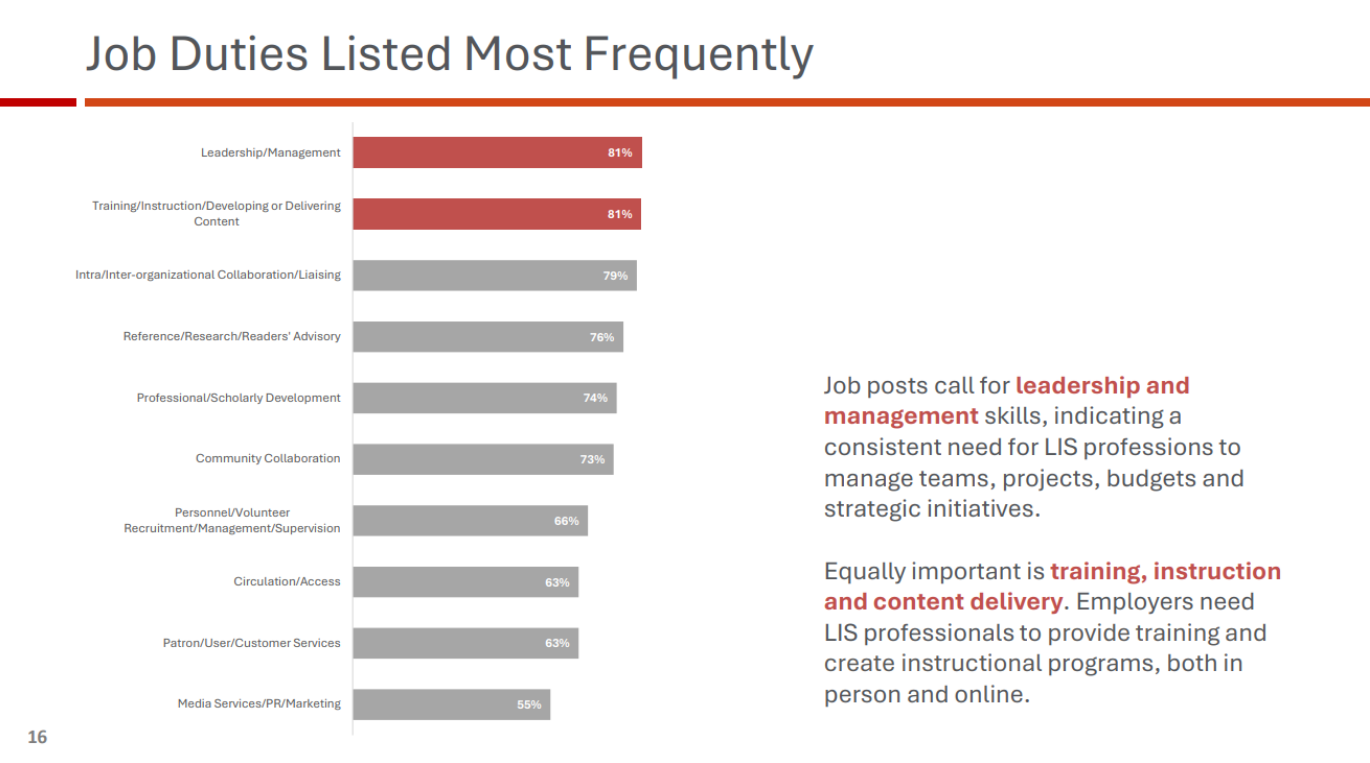
One of the most important moments of my MLIS degree happened when I was introduced to SJSU’s MLIS Skills at Work: A Snapshot of Job Postings report. My professor heavily emphasized the “Job Duties Listed Most Frequently” slide, shown here: 

The “Job Duties Listed Most Frequently” slide from the Spring 2025 report. 

At this point, I had no idea what kind of academic librarian I wanted to be; all I knew was how hard it would be to find a job in the economy I’d be graduating into. I made it my mission to acquire experience in as many of these job duty areas as possible before graduating. 

I had already worked circulation at a medical library during my undergraduate degree, and when I began my MLIS, I worked part-time in technical services at a law library. During my second year, I applied for a liaison practicum, gaining experience in instruction and liaison work. While reference wasn’t originally part of the practicum curriculum, I specifically asked to be trained on the desk so I could check off the “reference” skill from the SJSU report. (I was on a mission!) When the opportunity came for a second practicum, I could choose either another liaison practicum or an e-resources practicum. As much as I wanted to keep doing liaison work, I decided to strategically broaden my portfolio of skills, particularly since my program did not offer any courses or other learning opportunities about e-resources.  

Experimenting with all these different areas of librarianship helped me discover the type of librarian I wanted to be. While I loved digging my teeth into a huge e-journal spreadsheet, I realized I couldn’t do that for 40 hours a week. I was the most energized when working with patrons, either in the classroom or research consultations. I loved sitting out at the reference desk, soaking in the buzz of the library, even if nobody came by! This helped give me direction when I began my job search. On the other hand, my diverse portfolio of library experiences also gave me flexibility on the job market, which was important in an unpredictable environment. Additionally, my experience in collections, e-resources, and circulation makes me a stronger liaison librarian today. Understanding these elements of the library helps me better assist students and faculty who come to me with access issues, and I can collaborate more effectively with my colleagues across the library.  

All experience is experience 

All three of us FYALs took different paths to reach our current academic library positions. Although those paths were varied, they were each valuable in their own ways. All of the work, volunteer, and practicum experience we gained both inside and outside of libraries helped to make us competitive candidates on the job market and currently helps us to be the best librarians we can be! 

“What are your research interests?” “Hmm. I’ll get back to you.”

Commonalities across first-year academic librarians (FYALs) may or may not include imposter syndrome, teaching jitters, too much coffee, and navigating the life of an academic. A large part of what an academic is stems from their identity as a researcher, but as new librarians entering the university system for the first time, it is something to be reckoned with. Scholarly responsibilities, academic service, professional development, and others are all expected, but how do fresh library school graduates tackle these aspects while linearly following an interest that just makes sense? 

Now more than halfway through our first year as early-career librarians, the FYALs, Eleanor, Lisa, and M, wanted to share a peek into the thought processes in tackling the giant monster that consists of finding a research interest. 

Lisa: A Sea of Information, Even Within Myself

On Academic CV templates, the two sections that I always struggled with the most to fill were teaching philosophies and research philosophies. One of the first goals that I put for myself in the beginning of the school year was actually to find my identity as an instructor-researcher. Immediately, something my supervisor commented on was how it would be a long journey, often taking several years to really refine and clearly develop.  

Acknowledging that it would be a multi-year process, I started reading about different ways scholars describe their methods of conducting research and presenting their work, and an idea that I appreciated was the notion of a praxis. Borrowing ideas from critical race theory, the intersecting effects of identity, race, emotions, and critically examining how these elements coexist in research was a perspective that I didn’t think to bring into my daily work. Even though I am a research librarian by job title and supporting specific departments in Health Sciences and STEM, elements of myself bleed into the work that I do, whether subconsciously or consciously. Consequently, my thought process was that once my identity as a researcher was settled, I would be able to examine the big picture and see new perspectives that I contribute to.  

Although this is most definitely still a work in progress, I notice myself slowly finding projects that I continue to gravitate towards, words that I enjoy writing or reading more about, or research that makes me realize how fast time flies by. I am still very much tying up the shoelaces of my student projects and have been learning how to balance my work between teaching, consults, outreach, and my own research. Although I definitely do not feel like I have things under control right now, I hope to have some sort of routine where I will be able to balance the percentages of responsibilities and find myself with a clear identity as a librarian-instructor-researcher. 

M: Is It All Just Research? 

When I decided to go into academic libraries, I started hearing right away about how research was a key component of those jobs, so I would need to have a good answer for questions like “tell me about your research interests.” Initially, I used my master’s paper topic to answer that question, which was convenient – but it was really a cover up for the fact that I had no idea what “conducting research” actually meant. 

Until very recently, when I’ve thought about “conducting research,” I’ve pictured a long process that involves choosing a topic, developing a research question, getting IRB (Institutional Review Board) approval, designing and conducting a study/survey/interviews/focus groups, writing a paper about the findings, and getting it published in a peer-reviewed journal. The concept of trying to take that on, by myself or with a peer, and fit it in around other work has been overwhelming, but I thought I would have to make it happen somehow, because what else could research mean? 

There’s a group of new and new-ish librarians at my institution who have formed a group to read and discuss journal articles, share about projects we’ve been working on, and discuss things we’ve learned. At our most recent meeting, the topics of “finding a research interest” and “conducting research” came up. I was relieved to learn that I wasn’t the only one who was confused about what those phrases meant – in fact, most of us had the same questions. One colleague who has been an academic librarian for several years shared how she thinks about research, and her views were incredibly helpful. She said that from her perspective, almost all of the work we do every day is research. Learning about a new topic to help a student in a reference interview? That’s research. Developing a new workshop on an unfamiliar topic? That’s research. Coming up with a new process or procedure to make your workflow more efficient? That’s research, too – because in all of these cases, we’re investigating key questions, learning new things, and teaching them to others – and our findings from all of those instances are worthy of presentations and publications. It’s really just research all the way down. 

Eleanor: Creativity is Research, Too

In addition to being a librarian, I’m also a writer. A year ago, I thought these two parts of myself were totally unrelated. But as I’ve begun thinking about myself as a librarian researcher, I’m drawn to the possibilities of a creative-critical practice.  

Creative-critical research blends traditional scholarship with some kind of artistic expression, such as creative nonfiction, digital media, or performance art. While some may dismiss creative-critical research as “just” creative writing (and I would challenge that use of “just”!), creative-critical research is in fact powered by deep engagement with data, history, case studies, and critical theory. 

One of my favorite examples of creative-critical library research is “Invisible Stitches: A Semester at the Reference Desk, Quilted” (Weidner, 2025), a quilting project that foregrounds the “process” in “research process” and challenges the depersonalization of library labor. In her article, Weidner discusses the “Is it research?” question, noting how some viewers rejected the idea of quilting as creative-critical research. I see a connection between this dismissal and how other feminized labor, such as librarianship and teaching, is often devalued in the academy’s traditionally masculine culture.  

At a time when libraries are under persistent attack, a creative-critical approach helps us translate our work and research into impactful stories that excite our patrons. It can help challenge artificial hierarchies within the culture of research and welcome valuable, “non-traditional” ways of developing and deepening our collective knowledge into the academy. 

The Bigger Picture: The Value of Librarians as Researchers 

As the three of us discussed our personal experiences with research, we noticed several discrepancies. M is expected to do research in order to succeed in their role, but they are ineligible for faculty status and the benefits that come with it, such as tenure, increased academic freedom protections, and participation in university governance. On the other hand, Eleanor is a term faculty member, but she is not expected to do research (instead, her portfolio focuses on teaching and service). Lisa’s institution offers a mix of these two models. Librarians and faculty are in the same union, but librarians are reviewed for “continuing appointment” after a “preliminary appointment.” When we were applying for jobs last year, we all found it difficult to identify where our prospective employers fell on this spectrum.  

Much of this varies from institution to institution, but we think our experiences represent several troubling trends across higher education. Fewer and fewer institutions of higher education grant faculty status to librarians, but they may still expect their staff librarians to take on faculty-type duties (such as research and teaching) without the support that would be provided to faculty. At a time when both higher education and libraries are facing widespread attacks, it’s more critical than ever for our institutions to provide librarians with substantial academic freedom protections as we engage in the teaching and research they ask of us. When librarians still have faculty status, we also suffer from the “adjunctification” of higher education. Tenure-track positions are dwindling in favor of adjunct and term positions, which may not provide research support and certainly offer less stability. What do these trends indicate about how higher education values (or doesn’t value) librarians as researchers?  

Our expertise is information seeking and evaluation, which is important to disciplines across campus. At a time when the information world is transforming at a dizzying pace, we think it’s essential that higher education recalls the value of librarians as researchers–not just rhetorically, but through concrete, worker-friendly and intellectual freedom-first policies that make it easier for librarians to do meaningful research.

Tribute Post for Fobazi Ettarh

With immense sadness, the writers of ACRLog acknowledge the passing of Fobazi Ettarh, library worker and influential LIS scholar. If you are able to contribute, there is a GoFundMe established for Fobazi’s wife, Elena, to assist with the significant medical and end-of-life expenses. This post will include some reflections from ACRLog members about their interactions with Fobazi’s influential work.


The highest form of intellectual contribution a humanistic scholar can make is to provide people a way of understanding themselves and their situation in a new way; to spotlight a widespread challenge by naming it and describing its facets; to give people language to discuss it and thereby work against it to make their lives better. So many of us who read Vocational awe and librarianship: The lies we tell ourselves can remember the revelatory feeling of being seen and understood; the feeling of when you finally find that perfect word you’ve been searching for, multiplied many times over. This type of contribution is both very rare and a true gift to the field, both in an academic and practical sense, and one that extends beyond librarianship. Thank you, Fobazi! You continue to make a difference.

– Sam Winemiller

Fobazi, Fobazi, Fobazi: thank you. Your work resonates across librarianship and beyond. You do not simply contribute to existing conversations — you offer a research framework that gave many of us new language, new questions, and new accountability. Through your scholarship, you illuminate how systems of labor shape who is permitted to work, to belong, and to be recognized as fully human.

I am proud to be part of a field that has learned to name vocational awe as a real and impactful concept — and to take seriously the ways our profession can romanticize service, self-sacrifice, and institutional loyalty at the expense of workers’ well-being. Your work, Fobazi, exists within that critical tradition, and also pushes further. Where vocational awe asks us to interrogate the mythology of librarianship, your scholarship asks us to interrogate at what cost. You make it clear that devotion to the profession cannot substitute for justice within it. That access to work is not simply about passion or calling, but about policy, protection, and power. In doing so, you expand how we think about labor in librarianship and whose experiences expose the limits of institutional narratives about care and service.

To honor Fobazi is to refuse the comfort of vocational awe when it obscures harm. It is to remain committed to building professional cultures grounded not in myth, but in accountability, equity, and material support. Her work continues to give us tools: to ask harder questions, to examine institutional complicity, and to imagine more just systems of work and knowledge.

– Caelin Ross

I first had the pleasure to hear about Fobazi’s work as a graduate student when I was also going through mental health struggles on top of the daily work that I had while working part-time in multiple libraries. Thinking about work as a source of stress almost felt forbidden, as I should have been so grateful to even have these kinds of opportunities and chances in life. I had honestly never thought to examine how my dream job, the industry that I dreamt of working in for so long, could be the stem of where I was feeling anything remotely negative. To be seen as radical, especially in a sector stereotyped as being so traditional, is such a courageous and personal action, and the impact that it has on early-career librarians and students, thinking about entering the industry is immense. To be introduced to these kinds of concepts so early and develop workstyles, work ethics, and enter the workforce with a strong and healthy mind is something I wish for all library students to have. To be seen in the workplace, to make a difference every day, and to remain in the profession upholding values such as the ones that originally led us down this path is a gift. Thank you Fobazi for all that you have done for the profession and for the librarians all over the world, you are dearly missed. 

– Lisa Shin

Fobazi’s life and work were deeply informed by her identity as a Black, queer, disabled woman. While Fobazi is rightly appreciated for her groundbreaking scholarship in coining and developing the concept of vocational awe, I would encourage those who have found her work with vocational awe to be eye-opening to explore her work and words that more directly relate to disability, in the hopes that you’ll find them equally revelatory. A great place to start is Fobazi’s Killing Me Softly, a choose your own adventure-style text-based game, where you can explore the cumulative impacts of microaggressions and acculturative stress by playing either as a white, able-bodied gay man or a Black, straight, disabled woman. Her blog posts about coming out as disabled and intracommunity violence within the disabled community are also must-reads. 

Fobazi was outspoken about the frustrations of being disabled in a world with too few accommodations. One way to honor her life and contributions to the profession is by considering how you can more fully consider the access needs of your disabled colleagues and patrons, by taking actions such as wearing masks, providing equitable access via virtual meetings/webinars, and regularly listening to and learning from members of the disabled community.

– Violet Fox

I started graduate school in Fall 2020, and one of the very first things I read in my classes was Vocational Awe and Librarianship. The turmoil of the world at that time was absolutely leading me to place librarianship on a sacred pedestal; continuing on that path would have burnt me out quickly, because as Fobazi said, “Martyrdom is not a long-lasting career.” It also allowed me to take many steps back and look at the field critically before I well and truly entered it, learning and asking about the ways that librarianship has either failed or actively caused harm to others. I cannot overstate the impact that this article and her work as a whole has had on not only my career, but in so many library workers’ lives, and for that, thank you. When we are discussing a new program, assessing and evaluating one we already do, or generally ranting about academia as a whole, my coworkers and I are always referencing Vocational Awe. Beyond her academic work, though, this is a deep and tragic loss for those who loved her. I did not ever have the privilege of meeting or talking with Fobazi in person or online, but from all the tributes I have read over the last few weeks, knowing her was a true joy. I am so sorry to Elena, Ysabel, and everyone else in her life; this is a tremendous loss. 

– Emily Zerrenner

I was gutted to hear the news of Fobazi Ettarh’s passing earlier this year. Like many of us I first became aware of Fobazi and her work on social media in the mid-2010s, when the website formerly known as Twitter was in what I’ll always think of as its librarian and higher education heyday. Her foundational article on vocational awe remains a piece that I return to again and again, and I was so lucky to have the opportunity to see her invited presentation at the ACRL 2019 conference, too. As I was educating myself about antiracism within and beyond the workplace, as well as critical librarianship, following Fobazi and her work was one of the ways I learned the most. And I’m so grateful for what I have learned by listening to Fobazi as she shared her lived experience at the intersection of multiple marginalized identities. 

As a white able-bodied person I know that it is not the responsibility of folks of color to teach me about racism, nor disabled folks to teach me about ableism. Thank you, Fobazi, for sharing your experience and your research with us for so many years, you are already missed by so many.

– Maura Smale

Past ACRLog posts that directly reference Ettarh’s work: