Blogging by and for academic and research librarians
Category: Professional Development
For announcement of professional development opportunities and for discussions of professional development in academic librarianship or higher education.
Editor’s note: We welcome a guest blog post from Lexi Kadis, Teaching and Learning Librarian at the University of Maryland Libraries.
I was in a state of perpetual déjà vu throughout the Spring 2026 semester. Just a year ago, I was on the academic librarian job market—revising CVs, writing cover letters, interviewing (rinse and repeat)—and now, I was helping six Master of Library and Information Science (MLIS) graduate students navigate the job search process.
I work as the Teaching and Learning Librarian at University of Maryland Libraries where I am also a co-director of the Libraries’ Reference and Teaching Fellowship (RTF), a three-semester, scaffolded professional development program that prepares MLIS students to be academic librarians. Since its founding in 2015, the Fellowship has supported more than 50 Fellows and has a proven track record of helping students find jobs (I should know, as I am a 2025 RTF alumna myself!).
Over the past semester, I have learned that supporting MLIS students on the job market takes a great deal of time, energy, and emotional labor. While I am a part of a team of four librarians who mentor our Fellows, I understand that for many librarians, providing mentorship and guidance to graduate students is a siloed act of service to the profession. To that end, I wanted to share my experiences and perspectiveon how to provide effective and sustainable mentorship to MLIS students.
Don’t Be the Cure-All
I first want to acknowledge that many graduate students turn to their library supervisors and mentors for job search guidance because of a lack of support from MLIS programs. Many of our Fellows have noted that the coursework and infrastructure of their graduate program has not prepared them to apply for academic librarian positions. From knowing when to start applying to jobs to turning resumes into CVs to preparing for full day interviews with job presentations, the hidden curriculum of the academic library job process is not being taught in library science classes.
Given the deficit of structural support—something you may have experienced in your own MLIS program—it is easy to want to be a cure-all for your mentees. However, trying to provide all the solutions is not a sustainable model for mentorship, particularly when it comes to the job search process. Based on my own experience, it is important to clearly communicate to your graduate students the types of help you can provide and when they should seek support elsewhere. Even if their MLIS program does not have a robust job search support system, students may have access to a campus career center, for example, and you can direct them to these types of resources.
Synchronous Feedback is your Best Friend
Guiding MLIS students through the job search process is very time-consuming. Reviewing materials, practicing for interviews, and serving as references can quickly eat up your whole work week. That is why it is helpful to think of ways to reduce time spent on this aspect of mentorship. One of the best ways to save time is to provide synchronous feedback only for application materials (whether CVs, cover letters, job presentation slide decks, lesson plans, etc.). For our Fellowship, this typically looks like a 20-30 minute meeting where I meet with the Fellow to review their documents and to provide verbal feedback.
I have found that synchronous feedback has benefits for both mentors and graduate students. It takes significantly less time to read and comment on a cover letter in person or over Zoom as, compared to doing it asynchronously. Additionally, when providing live feedback, students get to ask you clarifying questions in real time. Our Fellows have also noted that synchronous feedback is more helpful because a mentor reading your cover letter mirrors a potential employer doing the same. Rather than receiving line by line edits, hearing someone’s gut reaction helps graduate students understand if a cover letter is written effectively and persuasively.
The Emotional and Invisible Labor of Mentorship
I want to conclude this post by recognizing the emotional labor that goes into mentoring MLIS graduate students. We all know that the job search process can be emotionally charged, especially in an increasingly competitive job market and an unstable world at large. Writing cover letters and preparing for interviews is a deeply personal and vulnerable process that can bring up questions of identity and various feelings. As mentors, we are not only helping students to navigate the job search, but also the emotional potholes that come along with it.
It is equally important to acknowledge that mentorship is often invisible labor. The guidance that library mentors provide to graduate students is invaluable but often overlooked or unseen as part of our professional portfolios. The lack of visibility contributes to the isolation of mentors from each other. Based on my work with a team of librarians to support our Fellows, I believe that mentorship is at its best when it is collaborative. We can become better mentors by learning from each other. I encourage everyone to share their ideas, advice, and resources for mentoring MLIS students within their networks and communities.
Lastly, I want to thank the librarians and LIS professionals who have mentored me over the course of my library science journey and education. I think mentorship is very much a pay-it-forward act of service, and I am very grateful to be able to be a mentor to current and future graduate students.
Copyright competency is about more than knowing the rules. It’s about knowing what the rules are trying to achieve and how libraries contribute to those goals.
If you have a legally inclined librarian in your life, you may have heard them lament the state of copyright education in MLIS programs. If not, then allow me. Several studies have highlighted the widespread lack of sufficient copyright education across MLIS programs, both in North America and abroad (Cross & Edwards, 2011; Dryden, 2010; Fernández-Molina et al., 2022; Gathegi & Burke, 2008; Schmidt & English, 2015). These studies also point out that, even in the LIS programs that do offer some form of copyright-focused course, many are elective as opposed to a requirement for matriculation; few of the courses are “rigorous” or are regularly updated alongside the evolving copyright environment (Kawooya et al., 2019); and ultimately, “very few courses at the master’s level provide for the minimal requirements in terms of copyright literacy for professionals —whether to carry out their own tasks and functions, or else to aid co-workers or users as effectively as possible” (Fernández-Molina et al., 2022, p. 6). In a 2014 survey, only 49% of academic librarians felt prepared to provide copyright support to library patrons (Charbonneau & Priehs, 2014), and those librarians—along with library deans (Eye, 2013)—expressed a desire for additional copyright training. I’d guess the results would be similar in 2026. My MLIS program did offer a copyright-focused course and I still needed several copyright professional development courses to feel competent.
Copyright competency is about more than knowing and following (and often over-complying with) the rules. It’s about knowing why the rules exist—what goals the law is trying to accomplish so as to benefit society, and how the current legal framework is or is not helping society reach those goals. Libraries can locate their contributions to these larger societal goals and thereby understand why and how copyright law allows us to do what we do. And we can often do more than we might think (e.g. thank you, fair use).
On the other side of the coin, copyright law can also restrict libraries from being able to do what they should be able to do. Contractual override of library exceptions and fair use rights, the Digital Millenium Copyright Act’s restrictive amendments to library copyright exceptions (17 U.S. Code § 108 b(2) and c(2)), and the Second Circuit’s unfortunate decision in the Internet Archive case on controlled digital lending are just a few examples of a tightening belt on libraries and our mission of sharing information for the public good. Libraries (read: librarians) need to know how to make their own case. We contribute in unique ways to the societal goals copyright is trying to accomplish. Yet, in conversations with copyright experts, I’ve heard this sentiment shared several times: “If someone proposed the idea of libraries today, they’d be laughed out of the room.” I don’t think they’re wrong.
So, yes, we need to pay more attention to copyright in MLIS programs. We need ongoing professional development about copyright as it evolves. We need to feel more prepared to inform folks about how copyright affects their work (for example, authors’ propensity to sign away their journal article copyrights with abandon is the “original sin” of the serials crisis). Fortunately, there are very smart people and organizations working hard in this arena. I’m sharing a few of my favorite resources here, in hopes that they help someone take a step toward more copyright confidence:
Quick Reference Resources
All things from Authors Alliance: Super reliable advisors on all things copyright, specializing in issues affecting higher ed and in support of authors “who want to serve the public good by sharing their creations broadly.” Along with their public-facing news, analysis, and updates about copyright, they also work directly with academic libraries, if you know of an interested dean.
Code of Best Practices in Fair Use for OER: An explanation of how fair use allows authors to reference/include content/diagrams from other works in new noncommercial texts (even if those other works are all-rights-reserved). Generally helpful examples of how fair use can be applied to authorship
Fair Use Fundamentals from Fair Use Week: A tidy and LibGuide-friendly infographic on how fair use supports the fundamental purpose of copyright and makes possible lots of uses we rely on every day. Also, consider celebrating Fair Use Week in February!
Steps in the Analysis of a U.S. Copyright Case (Enriquez, 2013): Even though the risk of legal action and legal penalty is quite low for academic libraries, for those who want to understand all possible outcomes of their copyright-related actions, this document is a simple overview of court procedures for copyright infringement cases.
CopyrightX: Libraries: For those who want a law school dive into copyright, this is worth the time.
Creative Commons Certificate Curriculum: The ultimate authority on how CC licenses work. This certificate program is great, and in the spirit of open sharing, CC also makes their curriculum materials publicly available.
Open Copyright Education Advisory Network (OCEAN): OCEAN is carrying forth the mantel of regular copyright professional development for cultural heritage institutions. Not copyright 101, but if you have a baseline understanding, their events are great.
Over the last few weeks, I had the opportunity to attend two virtual library conferences – the 2026 Southeast Collaborative Conference, and the Transforming Libraries for Graduate Students 2026 Virtual Conference. I wanted to use my blog for this month to reflect on what I learned from both of these experiences.
Southeast Collaborative Conference
This conference happened first, over three days in the second week of March. I thought the pacing of the conference was helpful, as they included breaks in the schedule so attendees could check in on our day jobs without missing any of the content. Additionally, most of the sessions were pre-recorded, which allowed the speakers to be active in the chat throughout the presentation, answering questions and responding to comments. I thought that really helped to recreate how an in-person conference feels, and the emphasis on engagement made sessions fun. I also really appreciated that the conference made all of the slides and materials available to participants as soon as the conference ended. Knowing that I can reference them later, and see the materials from sessions I couldn’t attend, means that I really got the most I could out of the conference experience.
I was excited to see a presentation on Generative AI Literacy from two librarians that I know from my UNC-Chapel Hill grad school days, including one librarian whom I took a class with! I learned a lot from the presentation that I can incorporate into my own AI instruction and workshops (with attribution, of course). The presenters even shared that they’re going to be developing asynchronous tutorials for Generative AI in libraries that will be freely available to anyone, and let attendees know that all events about Generative AI at the University Libraries are open to anyone, not just university affiliates. I had no idea that I could still join any of the trainings that are offered online, and am looking forward to signing up for as many as I can attend.
Additionally, I thought the keynote was extremely powerful. It featured state librarians from five states – North Carolina, South Carolina, Virginia, Georgia, and Tennessee. One of the only live presentations at this conference, these leaders spoke candidly and eloquently about the challenges facing all types of libraries and library systems today, and what they’re doing to meet them head-on. It was inspiring and made me glad all over again that I chose this career.
Transforming Libraries for Graduate Students
This conference was second, held over two afternoons in the third week of March. This conference took place over Zoom, in four-hour sessions each day with no breaks. The format was more challenging than the previous week’s, but still emphasized the importance of engagement between presenters and attendees. I was especially excited about this conference, because all of the programs I support are master’s and doctoral programs, and during this first year I’ve felt unsure at times of the best way to approach supporting these programs. I really hoped that I could learn some tips and tricks from the presenters.
Unsurprisingly, there were quite a few sessions about Generative AI at this conference as well. These presenters didn’t get into the nuts-and-bolts of how to get the most out of Gen AI the way the previous conference did, but I appreciated the contrast of this approach that focused more on platforms and how graduate students tend to engage with these tools. Between the two conferences, I was able to add a lot of different tools to my Gen AI toolbox.
Several presentations also focused on how to approach orientations and workshops for grad students differently than for undergrads. I present a lot of library orientation sessions, and librarians at my institution are currently being asked to make sure our workshop offerings are robust, so these sessions were especially relevant to me. I appreciated how presenters focused on acknowledging graduate students have unique needs and may be juggling additional responsibilities when compared to undergrads, so it’s important to make sure the library is giving them the tools and knowledge they need to accomplish their goals.
I do wish that the sessions had been a bit more focused on specific actions that attendees can take in their own libraries. It seemed like many presenters were focused on sharing their work and what was successful for them, but not as focused on how their successes could be adapted for other libraries. I would have liked to have a few more concrete programming ideas that I could take back to my own libraries. Perhaps that’s something that I could work on as a presentation of my own for a future iteration of this conference. I also wished that the conference had stretched an additional half hour to add a break in the middle. I think it would have helped with tiredness and staying on top of other work at the end of the day.
Overall Takeaways and Future Thoughts
Although I’ve been to several in-person conferences before, I had never participated in an online conference and wasn’t sure how the experience would translate. I love the feeling of walking into a conference and knowing that everyone is there to learn, meet fellow professionals and maybe make future friends, and get everything that we can out of the experience. I was worried that these conferences would be lacking in the camaraderie and excitement of an in-person setting. Although I didn’t get quite the same feeling as I do when I walk in the door of a convention center, I was really happy to find that both conferences were able to recreate similar vibes over online platforms.
It’s also important to recognize that online conferences lower a lot of barriers of participation for many people – including me! I’m lucky to be at an institution that strongly supports professional development, but even that support wouldn’t have been enough for me to travel to two conferences in subsequent weeks. Holding a conference online also means that the cost to participate is likely lower – or in the case of these two conferences, eliminated completely. I really appreciate both conferences’ commitment to access, affordability, and availability.
Overall, I had a great time and gained a lot from my participation in these conferences. I’ll definitely be keeping an eye out for registration to open next year – and maybe I’ll even submit a presentation proposal myself!
Editor’s note: We welcome a guest blog post from Angela Pashia, who was an academic librarian for 12 years before becoming an ICF-Certified (ACC) leadership coach.
For the first half of my library career, I was adamant that I didn’t want to move into any formal leadership role. I was an instruction and liaison librarian, and I loved working directly with students and faculty to teach critical information literacy. I also got to teach a credit bearing information literacy course on a regular basis, which gave me a lot of opportunities to practice using critical pedagogy. I valued these opportunities to challenge rigid hierarchies and empower students to shift from seeing themselves as just consumers to producers of information.
My vision of what it means to be in management did not align with these values at all.
Fast forward several years, through becoming a reluctant leader, learning that I absolutely loved the opportunity to develop a team, and then becoming a leadership coach for librarians… Now I work with library leaders who are struggling with similar challenges rooted in similar narratives about what it means to be an effective leader.
In this narrative, the leader knows everything about how everything in the unit functions, and always has an answer for how to move forward in any situation. It’s very clear that this leader is directing everything – whether that’s through giving orders or just through always handing out solutions to every situation, for team members who’ve learned that it’s simplest to just go ask what the leader thinks. It’s clear that this leader is the one making all of the decisions that keep this library functioning and moving forward.
The best version of this leader comes across as a very knowledgeable parental figure, telling you how things should be done because they care about you. But they’re still telling you what to do, instead of helping you learn to work through the process on your own. This leader does provide development opportunities for their staff, but that tends to focus on molding you to follow in their footsteps, regardless of whether that’s the best fit for you.
Another version of this leader just gives you instructions and then grades how well you followed those instructions each year on your annual evaluation. They may or may not provide the scaffolded lessons that you need to complete the assignment well.
We don’t see this leader admitting when they don’t know things or asking many questions or having doubts. We don’t see this leader actively sharing power with their team members in a way that would loosen up their control.
This narrative about effective leadership becomes problematic when a new leader steps into their position knowing that they don’t know everything yet. They need to ask questions, but fear that doing so will communicate that they’re not qualified for this role. And that leads to imposter syndrome.
And this narrative doesn’t fit those of us who value collaboration, empowerment, and shared governance. I resisted moving into a leadership position for years because I didn’t want to be the person telling people what to do. My clients need support in learning new ways to lead, because this narrative of leadership doesn’t fit their values, either.
And that’s why I fell in love with coaching.
For me, learning coaching skills, as defined and practiced by the International Coaching Federation (and described in my last post), provided a way to transfer the principles of critical pedagogy from the classroom to leading a team.
Banking Knowledge
I learned about the “banking method of education” long before I read Freire’s Pedagogy of the Oppressed. Students aren’t bank vaults waiting for us to deposit bits of knowledge. Genuine learning is a dialogic process between student and teacher, building toward the development of a critical consciousness. Instead of being the “sage on the stage,” we can better support student learning by being a “guide on the side.”
And yet, we love depositing bits of knowledge! Many of the leaders I work with feel helpful when they come up with a great solution to every problem their team members bring to them. Leading a team is different from teaching a classroom, but these are often missed opportunities to develop that team member’s skills.
When a team member comes to you for help with a problem, using a coaching approach shifts you from depositing a solution to engaging in a dialogic process. When you start with a question like, “What ideas have you already thought of?”, and then ask genuinely curious follow-up questions to workshop one of those ideas, they learn more about how your organization works. Depending on the context, that may include learning to think critically about embedding equity and accessibility into library services, programs, and policies.
Holistic Approach
Building on Freire’s work, bell hooks proposed an “engaged pedagogy” that recognizes both student and teacher as whole people actively participating in the learning dialog. Students are not just passive consumers of information, and both sides bring a lifetime of rich experiences and emotional lives into the classroom.
The leaders I work with recognize that this is true with their team members, as well, but don’t always feel prepared to respond effectively when emotions are affecting how team members are showing up. When they do open a conversation, it can turn into two hours of the team member venting about everything they’re dealing with, which throws their schedule into disarray and leaves them emotionally drained. So now they’re afraid to even open that conversation again. And it’s one thing to know this intellectually, but when you feel pressured to keep things moving as quickly as possible because your library is doing too much with too little, it’s easy to overlook the bigger picture.
Learning to effectively use a coaching model to structure your conversation can help you navigate some of these tricky situations. This approach provides a roadmap to acknowledge those emotions, dig below the surface to identify the root of the issue, and figure out a path forward. It takes practice to find the right balance of listening to what’s going on now before jumping into problem-solving mode, but these models provide guard rails to keep you from just getting stuck in complaints.
And building a habit of using these ICF-style coaching skills can create openings to find out what’s really going on for people.
Self-actualization
As part of this engaged pedagogy, hooks wrote that “teachers must be actively committed to a process of self-actualization that promotes their own wellbeing if they are to teach in a manner that empowers students” (p. 15). This includes ongoing learning and ongoing reflection.
A coaching approach to leadership also prioritizes your own wellbeing and ongoing learning. Developing a curious, open, nonjudgmental mindset requires you to give yourself space to reflect, consider other perspectives, and make sure that your emotions aren’t skewing your view of a given situation. To support librarians in their ongoing learning and development, I regularly write a newsletter about applying a coaching approach in your library.
And, although it’s not exactly connected to critical pedagogy, I’ve found that this self-actualization process helps to combat imposter syndrome. Explicitly adopting a leadership style that encourages curiosity and questions gives new leaders permission to admit to not already knowing everything. And that helps to support their well-being.
What questions does this spark for you?
I’d love to continue this discussion in the comments section!
References
hooks, b. (1994). Teaching to transgress: education as the practice of freedom. Routledge.
When I attended my first conference hosted by the Music Library Association (MLA) in Salt Lake City, UT this year, I expected to learn about music collections, cataloging standards, and emerging research resources.
I did learn those things. But what surprised me most—and became the central lesson of my experience—was the way the community’s professional culture fundamentally shaped a sense of belonging and opportunity through mentorship and openness.
The conference became a model for how professional gatherings can foster mentorship, generosity, and true inclusion. For a newcomer like me, this was transformative, demonstrating that professional culture defines not just what we learn, but how we join the field.
I arrived at the conference at a moment of professional transition. I had recently begun a new role as Humanities Librarian at the University of Chicago Library, serving as liaison to the Music Department and the Committee on Theater and Performance Studies. The position carries a particular sense of responsibility: it has been vacant for more than six years following the sudden and tragic passing of my predecessor.
While I come to this work with a background in performing arts and librarianship, I do not hold a PhD in music or a formal degree in the discipline. In a research environment like the University of Chicago—an institution known for intellectual rigor and strong disciplinary traditions—that reality can feel especially visible.
Without a dedicated internal mentor in music librarianship, I rely on the field’s insight for questions about publishing ecosystems, vendors, cataloging, and collection strategies, despite supportive supervision.
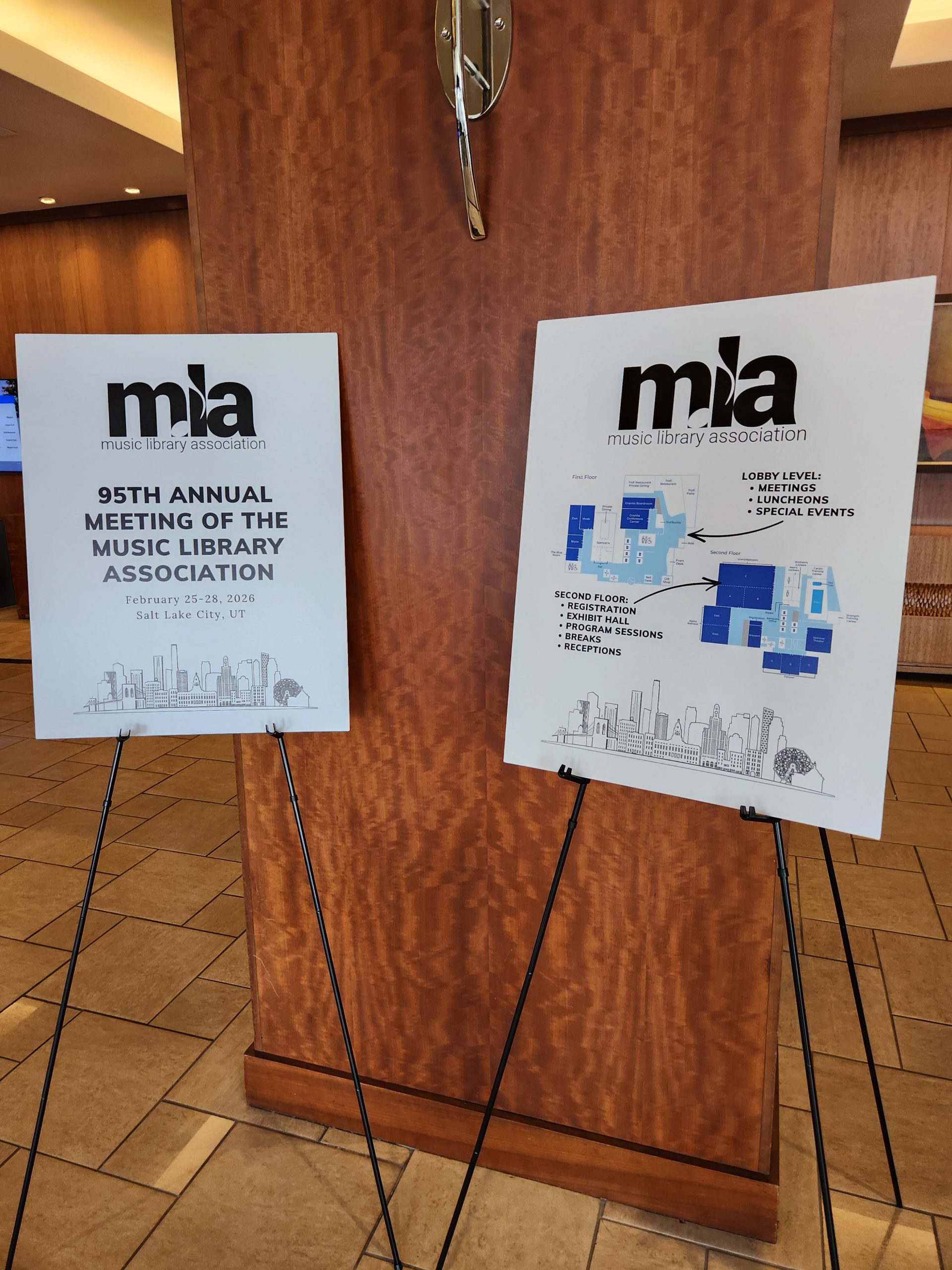
Conference in a single hotel with multiple maps, an app, Slack channel, and the MLA website with message board.
Entering a Specialized Field
At the same time, I am still learning to navigate the institution’s culture. The University of Chicago has long been associated with intellectual intensity, but also with a certain institutional privacy—an academic environment that can feel somewhat mysterious from the outside. Until quite recently, that culture was manifested literally: the university gates were locked, and visitors to the library needed special permission to enter. While those policies have evolved, the image remains a powerful metaphor for how knowledge institutions sometimes operate—carefully guarded, selective, and structured by invisible boundaries.
Entering music librarianship at the University of Chicago, with its infamous institutional boundaries, has made access, mentorship, and the feeling of community more than just professional benefits—they are essential. Attending the MLA conference thus became a pivotal way to encounter this culture directly.
Although conferences often promote networking and mentorship, those interactions are frequently shaped by hierarchy and credentials in practice.
What I encountered at MLA felt strikingly different.
The conference was intentionally designed for participation—large enough for expertise, but small enough for repeated encounters. All events were held at a single hotel, allowing conversations to flow freely.
Before the conference even began, first-time attendees were invited to a pre-conference Zoom orientation that introduced the organization and explained what the conference experience would look like. Programming was shared well in advance via the CVent platform, making it easy to explore sessions and plan a schedule in advance. Many sessions were also available to stream, supported by a technical team that ensured clear audio and video, as well as recorded access.
As an attendee at the ACRL Conference in 2026, I noticed the conference organizers aimed for similar intentionality in welcoming newcomers. However, in my experience, ACRL felt overwhelming and panel and program acceptance were extremely competitive–less than 10% of submissions were accepted. The biannual structure increased the pressure and made networking challenging, despite the welcoming atmosphere. Even after volunteering on several committees, I found it difficult to build connections and advocate for myself in such a large, bureaucratic organization. Unlike the targeted mentorship I experienced at MLA, ACRL’s size and structure made formal mentoring difficult.
Even the scheduling reflected thoughtful design. Interest group and committee meetings were held the week after the conference, so attendees would not have to choose between participating in the organization and attending sessions.
These structural choices were more than logistical: by reducing barriers and prioritizing access, the conference created a setting where real community, collaboration, and learning could happen—illustrating the central role culture plays in professional belonging.
A Conference Designed for Participation
Professional networking can be difficult, even after years in academic libraries. Finding the right balance between introducing oneself and participating, while respecting others’ boundaries, takes care. Mentorship remains professional labor.
Because of this, I was especially grateful to connect with potential mentors before the conference even began. Through introductions from fellow librarian Greg MacAyeal, I had the opportunity to speak with several MLA members beforehand. By the time I arrived at the conference, there were already familiar faces in the room.
That small shift made a tremendous difference. What might have been an intimidating professional gathering instead felt relational and welcoming from the beginning.
Music librarianship is an extraordinarily specialized field. It requires familiarity with music publishing ecosystems, performance traditions, archival preservation, metadata standards, and constantly evolving formats.
Yet the expertise present at the conference did not feel guarded.
It was shared.
Sessions ranged from discussions of contemporary score distribution to cataloging documentation and collaborative strategies for collection development in an era of budget constraints. Librarians, composers, and distributors discussed how new technologies are reshaping the circulation of music.
Rather than presenting polished solutions, many sessions invited collective problem-solving. Librarians spoke candidly about institutional constraints—budgets, workflows, and evolving research needs—and the conversations continued outside the formal sessions.
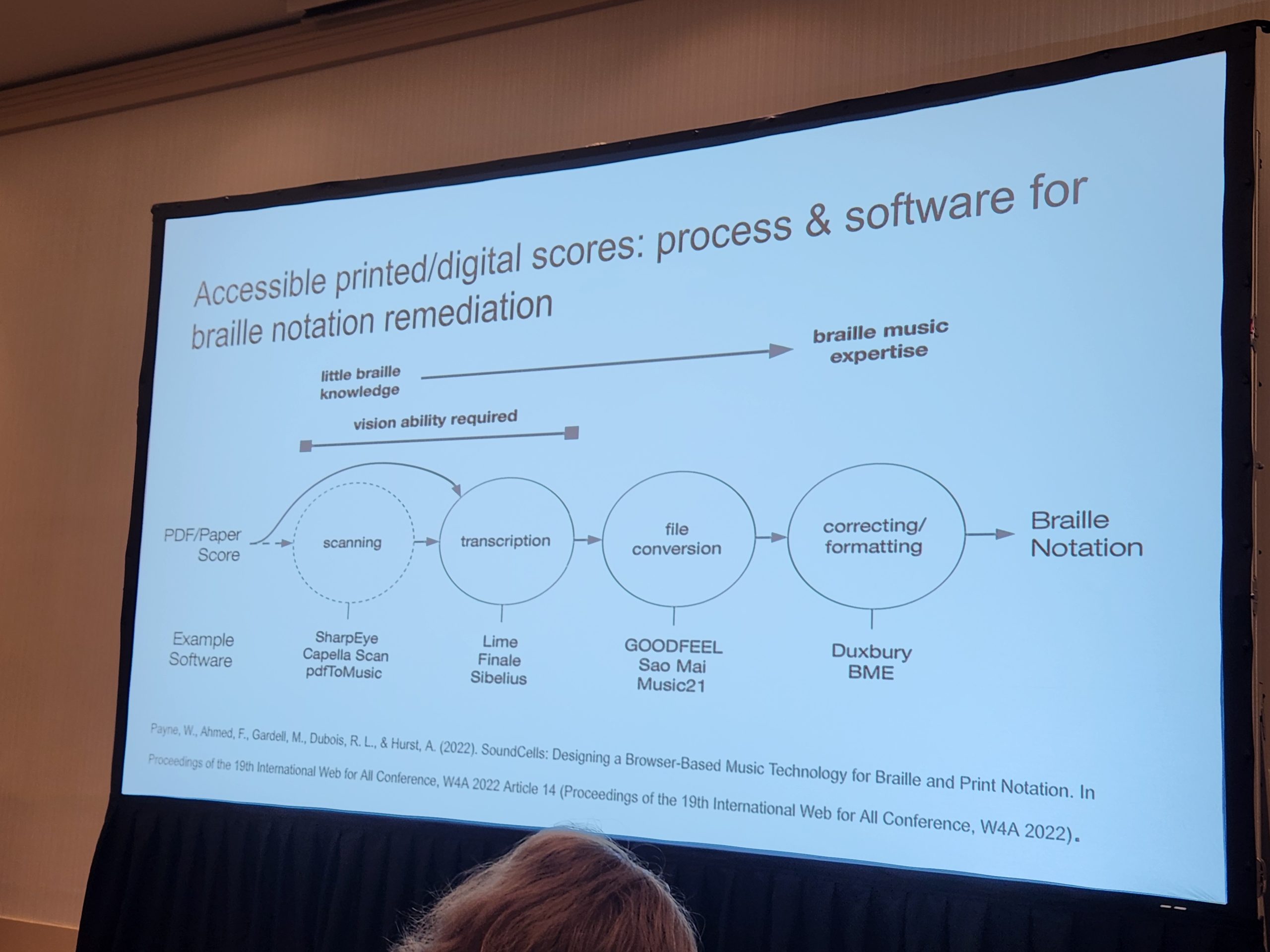
Slides from the presentation “ADA Title II and Music Libraries: Implications, Questions, and Strategies”, Kristi Bergland, Jackie Zook, and Anna Dimoula.
Scholarship, Performance, and Community
The cumulative effect was a sense of shared responsibility, not competition—a model of professional culture grounded in collective advancement, which sharply contrasts with other associations.
One evening event captured that spirit particularly well: Salon Night.
The program featured an eclectic mix of scholarship and performance. There were operatic performances and a playful musical adaptation of Oklahoma! titled Obsolescence, which was hilarious and resonated with our beautiful nerdy hearts. A presentation on queer disco clubs in 1970s New York examined dance floors as spaces of cultural memory and community formation.
Kathleen (Kathy) Abromeit, Head of the Conservatory Library with Oberlin College Libraries, shared work from her new book An Index to Spirituals, , reflecting on how a single reference question in the 1990s grew into decades of scholarly documentation of African American spirituals as both musical and cultural history.
What stood out was not just the diversity of topics but the way people engaged with them.
The room moved easily between laughter, curiosity, and deep reflection—at moments people laughed loudly, and at others they wiped away tears. People spoke about archives, music, and cultural memory with a level of care that extended beyond professional obligation.
Spaces that blend rigorous inquiry with genuine openness were rare in my experience before this conference. It illustrated that professional cultures built around mentorship and inclusivity can redefine how newcomers join, contribute, and thrive.
Confronting the Field’s History
The conference also made space for conversations that confronted the field’s historical foundations. In a presentation on early twentieth-century music librarianship, Veronica A. Wells examined how collection practices helped codify the Western canon in American libraries and ongoing questions regarding designation of “popular” music and the deeply racist, classicist cultural assumptions held by founding librarians.
Those decisions continue to shape music collections today, underscoring how professional cultures can reinforce or challenge exclusion—making intentionality in mentorship and inclusion all the more crucial.
Listening to that presentation, I found myself thinking about Audre Lorde’s essay The Master’s Tools Will Never Dismantle the Master’s House. Lorde reminds us that institutions can claim progressive intentions while still reproducing the structures they inherit.
Music libraries—like many cultural institutions—carry those histories.
The discussion explored how Indigenous musicians, composers, and archivists are reshaping libraries’ approaches to collections, programming, and performance archives. Speakers reflected on the complex musical histories shaped by the U.S. boarding school system, where Indigenous children were forcibly removed from their communities and subjected to assimilationist policies. Within and despite these institutions, students encountered new musical forms and instruments that later influenced emerging musical traditions, including early jazz.
The panel emphasized that these histories must be understood not as products of the institutions themselves, but as examples of Indigenous resilience, adaptation, and cultural continuity. It also underscored the importance of centering Indigenous voices in archival interpretation and programming, ensuring that contemporary collections and performances reflect the perspectives of the communities whose histories they document.
A Profession Built on Conversation
Part of what makes this kind of conversation possible may lie in the nature of the field itself.
Music librarianship is often described as specialized, but in practice, it resists neat disciplinary boundaries. Music moves across formats and cultural contexts—scores, recordings, dance traditions, film, archives, and the ephemeral materials that surround performance.
A question about a score can quickly become a question about performance practice, cultural history, copyright law, or digital preservation.
Supporting this work requires collaboration with performers, composers, archivists, scholars, technologists, and community historians.
In that sense, music librarianship cannot easily operate in silos. The work itself demands conversation.
And perhaps that necessity helps cultivate the intellectual generosity I witnessed throughout the conference.
Carrying the Lessons Forward
Returning to my work at the University of Chicago Library, I have been thinking about what made this experience so meaningful.
Part of it was structural: thoughtful conference design, accessible programming, and mentorship opportunities for first-time attendees.
But much of it was cultural.
The MLA community demonstrated that professional expertise need not be guarded to be respected, and that intellectual rigor can coexist with generosity and care. In a profession often shaped by institutional prestige and credentialed authority, that culture felt quietly radical.
For someone entering a specialized field without a traditional disciplinary pathway—and inheriting a role that has been absent for years—that kind of professional community is not simply helpful.
It is essential.
And in many ways, the message that stayed with me from the conference came down to a single moment.
At the opening session, incoming MLA president Holling Smith-Borne, director of the Wilson Music Library at Vanderbilt University, reflected on their first experience attending an MLA meeting. They shared that when they first attended the conference, they quietly asked themselves, “Should I bring my full self to this space?” Do I belong here?
But they described choosing something different—to challenge that voice of doubt and replace it with another: No. You belong here. No matter who you are.
Listening to that story, I realized that what I had experienced throughout the conference—the mentorship, the intellectual generosity, and the willingness to share expertise—was not accidental.
It was a community intentionally working to make that statement true.
Acknowledgments
I am deeply grateful to the colleagues who welcomed me into the Music Library Association community with generosity and care. Special thanks to Becca Fülöp, Amanda Dubose, Allison McClanahan, Bruce Evans, Ruthann McTyre, Tamar Barzel, Michelle Rivera, Misti Shaw, Sarah Ward, and Greg MacAyeal for mentorship, conversation, and encouragement throughout the conference.