All the Roads that Lead to Librarianship

Everyone’s path to academic libraries is a little different. Some of us start as public library pages in high school, some of us have been library student workers as undergrads, and some of us found libraries as a second career – whether the first one had to do with libraries or not. All of those paths are valid, and we have a lot to learn from each other and our different experiences.  

One common refrain that’s come up among this year’s ACRLog First-Year Academic Librarians (FYALs) is what we’ve learned from our past jobs – which could be anything from previous careers, library jobs that we had during grad school, and non-library jobs – that we use in our work today in academic libraries. Today, the three of us are sharing some thoughts and suggestions about what we learned from previous jobs. 

Lisa: Approaching all experiences with care…

As with many other students tight on finances, a part-time job was a must for me, ever since I reached the legal age of being able to work. Some positions that I credit my current career to and those that I highly recommend future librarians to think about are student internships and on-campus positions.  

A particular position that I look back fondly upon is being a residence don/assistant (I wrote a whole blog post about it in November in more detail if you’re interested: The Unexpected Overlaps Between a Don and a Librarian – ACRLog). The brainstorming of fun ideas to make sure there was sufficient attendance, conducting user needs analyses, working across campus with different partners, creating a safe atmosphere for everyone, while teaching students in one-on-one sessions, floor meetings, and workshops were so foundational. Especially in the beginning of the semester where first-year students would ask questions on everything and anything, I felt like I was back working at the public library where I was matching the right question to the right resource! This was where I volunteered at my first conference and did my dream project of hosting a month-long screening and events in celebration of the World Cup at a residence for international exchange students. Student engagement and targeting specific demographics for events that they would be interested in is something I think about on the daily, and having experience in student housing allowed me to first become exposed to the transferability of skills and knowledge in a post-secondary setting.  

In graduate school, attending an institution where there was sufficient support for student internship programs was necessary for me. I luckily had opportunities at several different libraries and departments where I feel that experience was incredibly beneficial in securing my current position. Scholarly communication, copyright, health sciences, and user engagement are some of the areas of academic libraries that I was introduced to. Due to the realistic constraints of living in an expensive city, having part-time jobs may be necessary, but trying to approach each opportunity, no matter what they might be, with an open mind and an empathic heart was essential for me to be generous with my time and energy to really apply what I was learning in school to positions outside the classroom.  

M: What does working with reporters and students have in common? 

For me, librarianship is a second career. I worked in my undergrad institution’s library as a student, then spent about six years in the communications and PR world before going to grad school for my MSLS (with a pretty random half-year stint in the federal government mixed in too). In grad school, I was able to work and volunteer in several different libraries. I also worked for a year at the campus performing arts organization’s box office.  

This is a pretty eclectic work history. What stands out to me the most now is that I use something that I learned at all of these past jobs, whether that’s a workplace lesson, a skill, or just general information, in my current academic library job almost every day. A lot of the knowledge, skills, and experience that I use now are also things that I hadn’t thought I would ever use again. I learned how to connect people with the information they need during my time in comms and PR – back then, I was connecting reporters with sources; now, I connect students with books and articles, but the fundamentals are the same. I learned how to intake random requests in communications and at the box office and figure out what people actually needed; now, I know what questions to ask students when they reach out and how not to let their panic get to me when they’re worried about a deadline (because reporters are always on deadline). I learned how to write a great proposal for a conference when I worked for the PR firm; now, I can write them for myself and help out my colleagues too. For my first few years in communications, I was also a scheduler; now, I know how to stay on top of my own calendar and also keep a lot of dates and deadlines in my head (and save my fellow librarians from accidentally scheduling a meeting for a holiday). I volunteered at a public library during grad school and now I know what things like “shelf-reading” mean (something library school doesn’t teach you). These are just the first few that come to mind – I could definitely keep going.  

I think there are a few important points to take away from these examples. First, librarianship is a career where a lot of different experiences can translate – and translate well. It’s also hard to get experience in libraries. I would encourage anyone who’s interested in this career path to think creatively about what past experiences you have and how you can apply them to the library world – there’s more overlap than you would think. Additionally, but on the same theme, I would encourage people who are thinking about this career path or who are early into it to try to say “yes” to jobs, volunteer opportunities, and anything else, even if you think it won’t be relevant. You don’t know which of the lessons you learned in a job five years previously might turn out to be relevant during your first few years as an academic librarian. All experience is valuable – don’t discount or write off anything! 

Eleanor: Jack of all trades, master of some  

One of the most important moments of my MLIS degree happened when I was introduced to SJSU’s MLIS Skills at Work: A Snapshot of Job Postings report. My professor heavily emphasized the “Job Duties Listed Most Frequently” slide, shown here: 
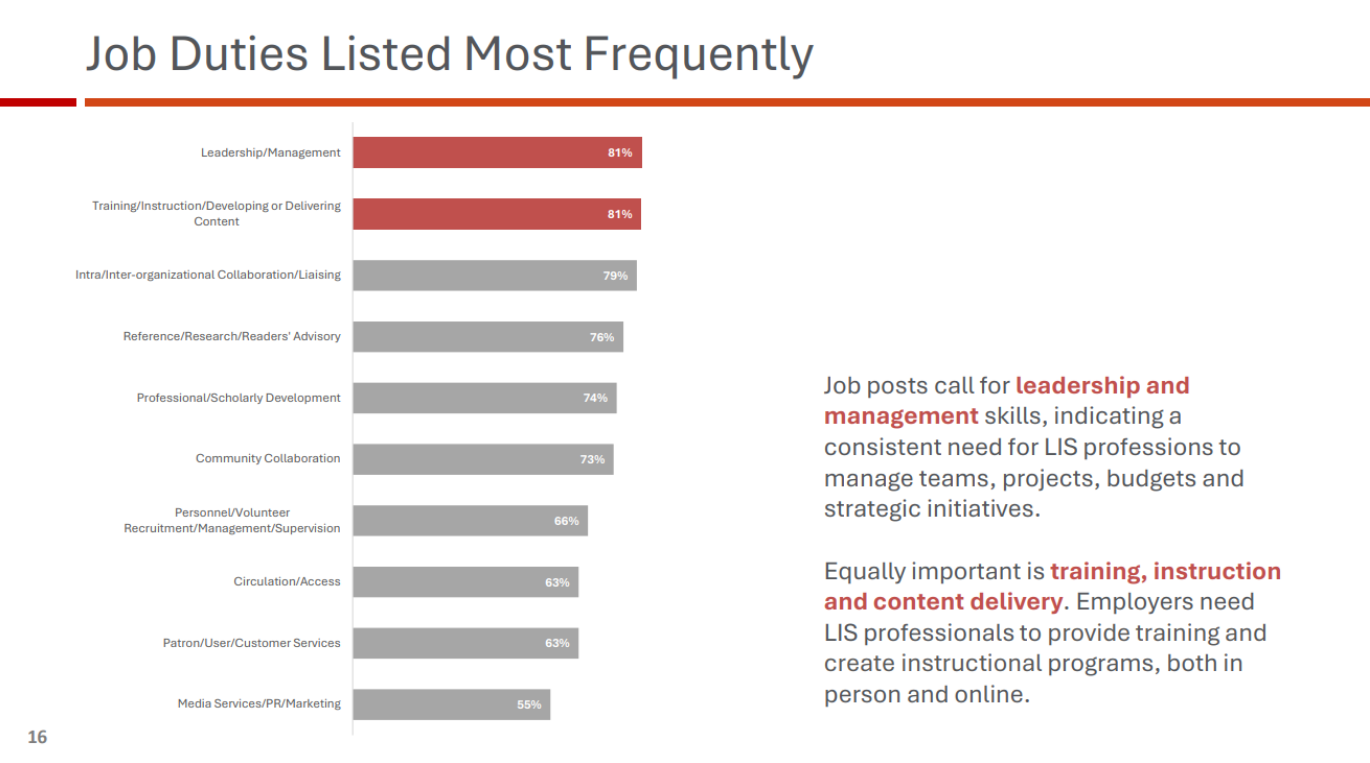
The “Job Duties Listed Most Frequently” slide from the Spring 2025 report. 

At this point, I had no idea what kind of academic librarian I wanted to be; all I knew was how hard it would be to find a job in the economy I’d be graduating into. I made it my mission to acquire experience in as many of these job duty areas as possible before graduating. 

I had already worked circulation at a medical library during my undergraduate degree, and when I began my MLIS, I worked part-time in technical services at a law library. During my second year, I applied for a liaison practicum, gaining experience in instruction and liaison work. While reference wasn’t originally part of the practicum curriculum, I specifically asked to be trained on the desk so I could check off the “reference” skill from the SJSU report. (I was on a mission!) When the opportunity came for a second practicum, I could choose either another liaison practicum or an e-resources practicum. As much as I wanted to keep doing liaison work, I decided to strategically broaden my portfolio of skills, particularly since my program did not offer any courses or other learning opportunities about e-resources.  

Experimenting with all these different areas of librarianship helped me discover the type of librarian I wanted to be. While I loved digging my teeth into a huge e-journal spreadsheet, I realized I couldn’t do that for 40 hours a week. I was the most energized when working with patrons, either in the classroom or research consultations. I loved sitting out at the reference desk, soaking in the buzz of the library, even if nobody came by! This helped give me direction when I began my job search. On the other hand, my diverse portfolio of library experiences also gave me flexibility on the job market, which was important in an unpredictable environment. Additionally, my experience in collections, e-resources, and circulation makes me a stronger liaison librarian today. Understanding these elements of the library helps me better assist students and faculty who come to me with access issues, and I can collaborate more effectively with my colleagues across the library.  

All experience is experience 

All three of us FYALs took different paths to reach our current academic library positions. Although those paths were varied, they were each valuable in their own ways. All of the work, volunteer, and practicum experience we gained both inside and outside of libraries helped to make us competitive candidates on the job market and currently helps us to be the best librarians we can be! 
Thinking about Contract Work… Positively!  

As a first-year academic librarian on a one-year contract, I am slowly feeling the pressure of time creeping on me as I navigate the job market once again. A previous blog post by YoonHee Lee, a former FYAL (first-year academic librarian, also Korean-Canadian :)), helped me to digest the precarity of contract positions in academic libraries with their thoughtful writing: https://acrlog.org/2019/12/21/reflecting-on-contract-work-and-precarity/ I wanted to build on this by sharing of some of the ways I approach my work, many thousands of kilometres away from home, and the strategies I use to cope with learning, understanding, and enjoying my life even as the clock is ticking.  

Changing my mindset  

Like law graduates doing articling, or doctors being matched for residencies, I came around to the idea of these one-year contracts replacing sabbaticals or parental leaves as a sort of testing the waters of a position. Is academic librarianship even right for me, what are some of the things I look for in an institution, what does a good workplace dynamic look like, what are must-have supports I need in a workplace, what is a good city to live, and so on.  The positive aspects according to the survey participants from Mcniff & Carter’s 2022 study are also reinforced by gaining experiences in different settings and developing social networks within academic institutions. Whenever I think that I am over-compensating by fixating my thoughts on the positive aspects, I take solace in reading interviewees’ transcripts, statistics, and discussions, and it helps to reframe my mindset in a more beneficial way.  

Tackling Manageable Projects  

The constraints of a year-long contract are most felt when I am thinking about projects, committees, and organizations to join. Since I don’t know where I will be in a couple of months, it’s hard to write my name down for something when a role comes up or even choose which email to register for a professional association with. Something I do to counterbalance this wishy-washy feeling is to actively seek partnerships in the library or projects I can help with in the short run. For instance, even though I am a research librarian and outreach is not explicitly expected of me, I work with the outreach department during exam seasons to help with crafts, games, and opportunities to share what I do at the library with students. Another workshop I did recently combined my background (although limited) in scholarly communication on how to publish in STEM for the first time, with the engineering and scholarly communications librarian. Finding opportunities that I can focus on for the short-term also allows me to get projects from ideation to delivery effectively while showing progress in my skills and knowledge as a new librarian.  

Finding the Small Joys  

There is a rising internet star in South Korea, an editor named Kim Min-Kyung of the publisher Min-um-sa. Her attitude towards life is something that I have been finding refreshing these days. For example, if someone was talking for a really long time and was going on and on about something that I couldn’t follow, instead of cutting them off verbally, she would instead internally think inside her head like, “Wow, how long can this person talk for, this is amazing,” or “Wow, would I be ever able to talk as long as them,” to create some fun and excitement in situations that would otherwise be difficult to quietly sit through. Ways I took some of her advice in my work is finding a laughing buddy at work ie. someone who I would have an easy time communicating or talking to on the daily, finding a peaceful spot on campus to read at, putting holds on books and DVDs in the collection to pick up before work, and going to events on campus from student symposiums, community lectures, to Indigenous walks.  

Concluding Thoughts

As new graduates start to look for work, and as old graduates’ contracts run out, the job market is starting to come alive with new positions and deadlines and stress, but also with the excitement of new positions and beginnings. Uncertainty and ambiguity are some unavoidable aspects academia that I hope will change (or are they avoidable?), but like all things in institutions, change is slow, and so for now, we can only do the best with what we have by being kind and showing gratitude wherever possible. I purposely avoided talking about the negative aspects of contract work in the post as that list is just endless. However, I am happy to connect with any library students or others on contract if anyone needs a set of ears to rant on! 

Takeaways from Two Virtual Library Conferences

Over the last few weeks, I had the opportunity to attend two virtual library conferences – the 2026 Southeast Collaborative Conference, and the Transforming Libraries for Graduate Students 2026 Virtual Conference. I wanted to use my blog for this month to reflect on what I learned from both of these experiences.

Southeast Collaborative Conference

This conference happened first, over three days in the second week of March. I thought the pacing of the conference was helpful, as they included breaks in the schedule so attendees could check in on our day jobs without missing any of the content. Additionally, most of the sessions were pre-recorded, which allowed the speakers to be active in the chat throughout the presentation, answering questions and responding to comments. I thought that really helped to recreate how an in-person conference feels, and the emphasis on engagement made sessions fun. I also really appreciated that the conference made all of the slides and materials available to participants as soon as the conference ended. Knowing that I can reference them later, and see the materials from sessions I couldn’t attend, means that I really got the most I could out of the conference experience.

I was excited to see a presentation on Generative AI Literacy from two librarians that I know from my UNC-Chapel Hill grad school days, including one librarian whom I took a class with! I learned a lot from the presentation that I can incorporate into my own AI instruction and workshops (with attribution, of course). The presenters even shared that they’re going to be developing asynchronous tutorials for Generative AI in libraries that will be freely available to anyone, and let attendees know that all events about Generative AI at the University Libraries are open to anyone, not just university affiliates. I had no idea that I could still join any of the trainings that are offered online, and am looking forward to signing up for as many as I can attend.

Additionally, I thought the keynote was extremely powerful. It featured state librarians from five states – North Carolina, South Carolina, Virginia, Georgia, and Tennessee. One of the only live presentations at this conference, these leaders spoke candidly and eloquently about the challenges facing all types of libraries and library systems today, and what they’re doing to meet them head-on. It was inspiring and made me glad all over again that I chose this career.

Transforming Libraries for Graduate Students

This conference was second, held over two afternoons in the third week of March. This conference took place over Zoom, in four-hour sessions each day with no breaks. The format was more challenging than the previous week’s, but still emphasized the importance of engagement between presenters and attendees. I was especially excited about this conference, because all of the programs I support are master’s and doctoral programs, and during this first year I’ve felt unsure at times of the best way to approach supporting these programs. I really hoped that I could learn some tips and tricks from the presenters.

Unsurprisingly, there were quite a few sessions about Generative AI at this conference as well. These presenters didn’t get into the nuts-and-bolts of how to get the most out of Gen AI the way the previous conference did, but I appreciated the contrast of this approach that focused more on platforms and how graduate students tend to engage with these tools. Between the two conferences, I was able to add a lot of different tools to my Gen AI toolbox.

Several presentations also focused on how to approach orientations and workshops for grad students differently than for undergrads. I present a lot of library orientation sessions, and librarians at my institution are currently being asked to make sure our workshop offerings are robust, so these sessions were especially relevant to me. I appreciated how presenters focused on acknowledging graduate students have unique needs and may be juggling additional responsibilities when compared to undergrads, so it’s important to make sure the library is giving them the tools and knowledge they need to accomplish their goals.

I do wish that the sessions had been a bit more focused on specific actions that attendees can take in their own libraries. It seemed like many presenters were focused on sharing their work and what was successful for them, but not as focused on how their successes could be adapted for other libraries. I would have liked to have a few more concrete programming ideas that I could take back to my own libraries. Perhaps that’s something that I could work on as a presentation of my own for a future iteration of this conference. I also wished that the conference had stretched an additional half hour to add a break in the middle. I think it would have helped with tiredness and staying on top of other work at the end of the day.

Overall Takeaways and Future Thoughts

Although I’ve been to several in-person conferences before, I had never participated in an online conference and wasn’t sure how the experience would translate. I love the feeling of walking into a conference and knowing that everyone is there to learn, meet fellow professionals and maybe make future friends, and get everything that we can out of the experience. I was worried that these conferences would be lacking in the camaraderie and excitement of an in-person setting. Although I didn’t get quite the same feeling as I do when I walk in the door of a convention center, I was really happy to find that both conferences were able to recreate similar vibes over online platforms.

It’s also important to recognize that online conferences lower a lot of barriers of participation for many people – including me! I’m lucky to be at an institution that strongly supports professional development, but even that support wouldn’t have been enough for me to travel to two conferences in subsequent weeks. Holding a conference online also means that the cost to participate is likely lower – or in the case of these two conferences, eliminated completely. I really appreciate both conferences’ commitment to access, affordability, and availability.

Overall, I had a great time and gained a lot from my participation in these conferences. I’ll definitely be keeping an eye out for registration to open next year – and maybe I’ll even submit a presentation proposal myself!

“What are your research interests?” “Hmm. I’ll get back to you.”

Commonalities across first-year academic librarians (FYALs) may or may not include imposter syndrome, teaching jitters, too much coffee, and navigating the life of an academic. A large part of what an academic is stems from their identity as a researcher, but as new librarians entering the university system for the first time, it is something to be reckoned with. Scholarly responsibilities, academic service, professional development, and others are all expected, but how do fresh library school graduates tackle these aspects while linearly following an interest that just makes sense? 

Now more than halfway through our first year as early-career librarians, the FYALs, Eleanor, Lisa, and M, wanted to share a peek into the thought processes in tackling the giant monster that consists of finding a research interest. 

Lisa: A Sea of Information, Even Within Myself

On Academic CV templates, the two sections that I always struggled with the most to fill were teaching philosophies and research philosophies. One of the first goals that I put for myself in the beginning of the school year was actually to find my identity as an instructor-researcher. Immediately, something my supervisor commented on was how it would be a long journey, often taking several years to really refine and clearly develop.  

Acknowledging that it would be a multi-year process, I started reading about different ways scholars describe their methods of conducting research and presenting their work, and an idea that I appreciated was the notion of a praxis. Borrowing ideas from critical race theory, the intersecting effects of identity, race, emotions, and critically examining how these elements coexist in research was a perspective that I didn’t think to bring into my daily work. Even though I am a research librarian by job title and supporting specific departments in Health Sciences and STEM, elements of myself bleed into the work that I do, whether subconsciously or consciously. Consequently, my thought process was that once my identity as a researcher was settled, I would be able to examine the big picture and see new perspectives that I contribute to.  

Although this is most definitely still a work in progress, I notice myself slowly finding projects that I continue to gravitate towards, words that I enjoy writing or reading more about, or research that makes me realize how fast time flies by. I am still very much tying up the shoelaces of my student projects and have been learning how to balance my work between teaching, consults, outreach, and my own research. Although I definitely do not feel like I have things under control right now, I hope to have some sort of routine where I will be able to balance the percentages of responsibilities and find myself with a clear identity as a librarian-instructor-researcher. 

M: Is It All Just Research? 

When I decided to go into academic libraries, I started hearing right away about how research was a key component of those jobs, so I would need to have a good answer for questions like “tell me about your research interests.” Initially, I used my master’s paper topic to answer that question, which was convenient – but it was really a cover up for the fact that I had no idea what “conducting research” actually meant. 

Until very recently, when I’ve thought about “conducting research,” I’ve pictured a long process that involves choosing a topic, developing a research question, getting IRB (Institutional Review Board) approval, designing and conducting a study/survey/interviews/focus groups, writing a paper about the findings, and getting it published in a peer-reviewed journal. The concept of trying to take that on, by myself or with a peer, and fit it in around other work has been overwhelming, but I thought I would have to make it happen somehow, because what else could research mean? 

There’s a group of new and new-ish librarians at my institution who have formed a group to read and discuss journal articles, share about projects we’ve been working on, and discuss things we’ve learned. At our most recent meeting, the topics of “finding a research interest” and “conducting research” came up. I was relieved to learn that I wasn’t the only one who was confused about what those phrases meant – in fact, most of us had the same questions. One colleague who has been an academic librarian for several years shared how she thinks about research, and her views were incredibly helpful. She said that from her perspective, almost all of the work we do every day is research. Learning about a new topic to help a student in a reference interview? That’s research. Developing a new workshop on an unfamiliar topic? That’s research. Coming up with a new process or procedure to make your workflow more efficient? That’s research, too – because in all of these cases, we’re investigating key questions, learning new things, and teaching them to others – and our findings from all of those instances are worthy of presentations and publications. It’s really just research all the way down. 

Eleanor: Creativity is Research, Too

In addition to being a librarian, I’m also a writer. A year ago, I thought these two parts of myself were totally unrelated. But as I’ve begun thinking about myself as a librarian researcher, I’m drawn to the possibilities of a creative-critical practice.  

Creative-critical research blends traditional scholarship with some kind of artistic expression, such as creative nonfiction, digital media, or performance art. While some may dismiss creative-critical research as “just” creative writing (and I would challenge that use of “just”!), creative-critical research is in fact powered by deep engagement with data, history, case studies, and critical theory. 

One of my favorite examples of creative-critical library research is “Invisible Stitches: A Semester at the Reference Desk, Quilted” (Weidner, 2025), a quilting project that foregrounds the “process” in “research process” and challenges the depersonalization of library labor. In her article, Weidner discusses the “Is it research?” question, noting how some viewers rejected the idea of quilting as creative-critical research. I see a connection between this dismissal and how other feminized labor, such as librarianship and teaching, is often devalued in the academy’s traditionally masculine culture.  

At a time when libraries are under persistent attack, a creative-critical approach helps us translate our work and research into impactful stories that excite our patrons. It can help challenge artificial hierarchies within the culture of research and welcome valuable, “non-traditional” ways of developing and deepening our collective knowledge into the academy. 

The Bigger Picture: The Value of Librarians as Researchers 

As the three of us discussed our personal experiences with research, we noticed several discrepancies. M is expected to do research in order to succeed in their role, but they are ineligible for faculty status and the benefits that come with it, such as tenure, increased academic freedom protections, and participation in university governance. On the other hand, Eleanor is a term faculty member, but she is not expected to do research (instead, her portfolio focuses on teaching and service). Lisa’s institution offers a mix of these two models. Librarians and faculty are in the same union, but librarians are reviewed for “continuing appointment” after a “preliminary appointment.” When we were applying for jobs last year, we all found it difficult to identify where our prospective employers fell on this spectrum.  

Much of this varies from institution to institution, but we think our experiences represent several troubling trends across higher education. Fewer and fewer institutions of higher education grant faculty status to librarians, but they may still expect their staff librarians to take on faculty-type duties (such as research and teaching) without the support that would be provided to faculty. At a time when both higher education and libraries are facing widespread attacks, it’s more critical than ever for our institutions to provide librarians with substantial academic freedom protections as we engage in the teaching and research they ask of us. When librarians still have faculty status, we also suffer from the “adjunctification” of higher education. Tenure-track positions are dwindling in favor of adjunct and term positions, which may not provide research support and certainly offer less stability. What do these trends indicate about how higher education values (or doesn’t value) librarians as researchers?  

Our expertise is information seeking and evaluation, which is important to disciplines across campus. At a time when the information world is transforming at a dizzying pace, we think it’s essential that higher education recalls the value of librarians as researchers–not just rhetorically, but through concrete, worker-friendly and intellectual freedom-first policies that make it easier for librarians to do meaningful research.

Mic Drop: Belonging, Mentorship, and Professional Culture at the Music Library Association

When I attended my first conference hosted by the Music Library Association (MLA) in Salt Lake City, UT this year, I expected to learn about music collections, cataloging standards, and emerging research resources.

I did learn those things. But what surprised me most—and became the central lesson of my experience—was the way the community’s professional culture fundamentally shaped a sense of belonging and opportunity through mentorship and openness.

The conference became a model for how professional gatherings can foster mentorship, generosity, and true inclusion. For a newcomer like me, this was transformative, demonstrating that professional culture defines not just what we learn, but how we join the field.

I arrived at the conference at a moment of professional transition. I had recently begun a new role as Humanities Librarian at the University of Chicago Library, serving as liaison to the Music Department and the Committee on Theater and Performance Studies. The position carries a particular sense of responsibility: it has been vacant for more than six years following the sudden and tragic passing of my predecessor.

While I come to this work with a background in performing arts and librarianship, I do not hold a PhD in music or a formal degree in the discipline. In a research environment like the University of Chicago—an institution known for intellectual rigor and strong disciplinary traditions—that reality can feel especially visible.

Without a dedicated internal mentor in music librarianship, I rely on the field’s insight for questions about publishing ecosystems, vendors, cataloging, and collection strategies, despite supportive supervision.

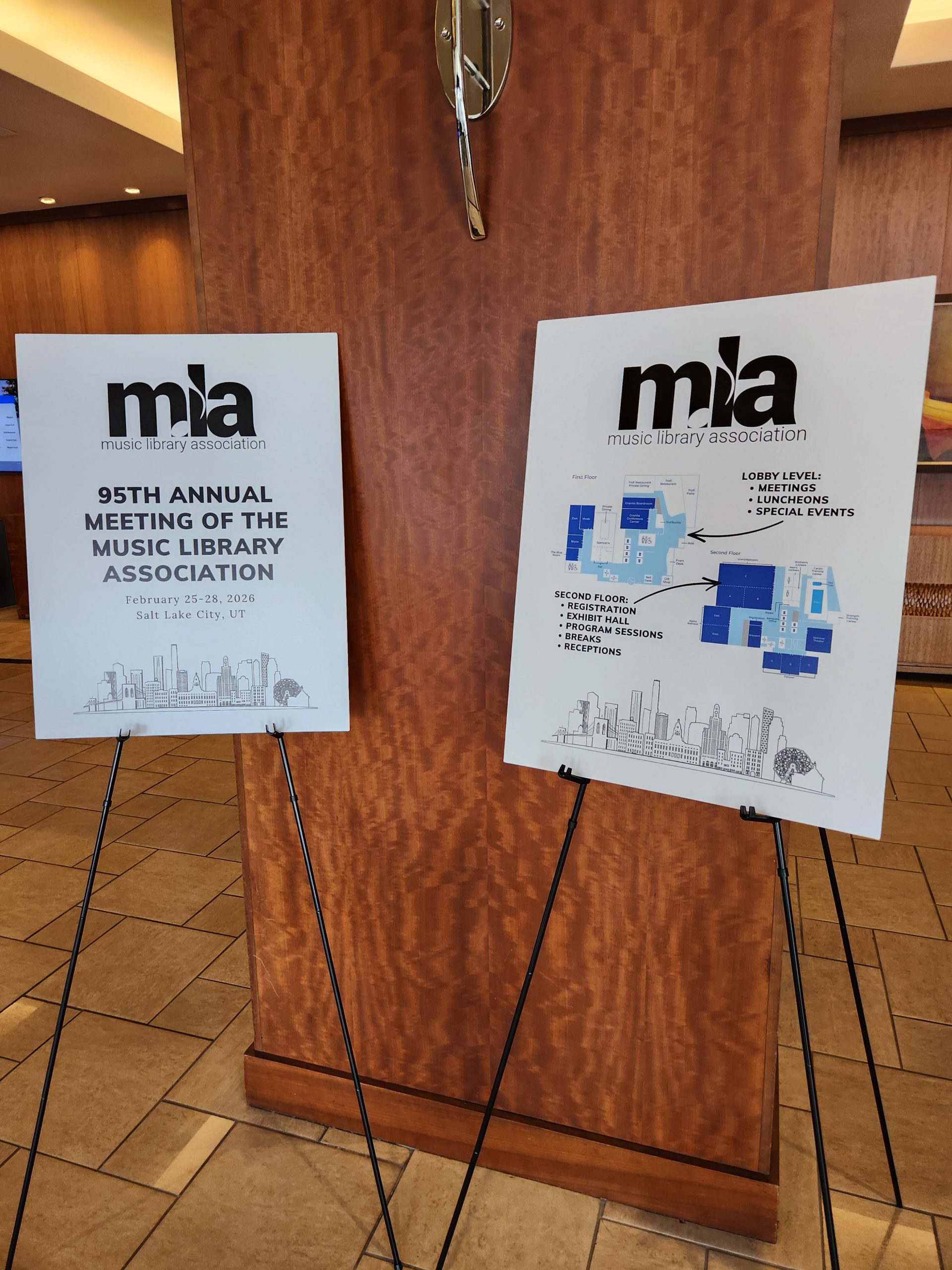
Conference in a single hotel with multiple maps, an app, Slack channel, and the MLA website with message board.

Entering a Specialized Field

At the same time, I am still learning to navigate the institution’s culture. The University of Chicago has long been associated with intellectual intensity, but also with a certain institutional privacy—an academic environment that can feel somewhat mysterious from the outside. Until quite recently, that culture was manifested literally: the university gates were locked, and visitors to the library needed special permission to enter. While those policies have evolved, the image remains a powerful metaphor for how knowledge institutions sometimes operate—carefully guarded, selective, and structured by invisible boundaries.

Entering music librarianship at the University of Chicago, with its infamous institutional boundaries, has made access, mentorship, and the feeling of community more than just professional benefits—they are essential. Attending the MLA conference thus became a pivotal way to encounter this culture directly.

Although conferences often promote networking and mentorship, those interactions are frequently shaped by hierarchy and credentials in practice.

What I encountered at MLA felt strikingly different.

The conference was intentionally designed for participation—large enough for expertise, but small enough for repeated encounters. All events were held at a single hotel, allowing conversations to flow freely.

Before the conference even began, first-time attendees were invited to a pre-conference Zoom orientation that introduced the organization and explained what the conference experience would look like. Programming was shared well in advance via the CVent platform, making it easy to explore sessions and plan a schedule in advance. Many sessions were also available to stream, supported by a technical team that ensured clear audio and video, as well as recorded access.

As an attendee at the ACRL Conference in 2026, I noticed the conference organizers aimed for similar intentionality in welcoming newcomers. However, in my experience, ACRL felt overwhelming and panel and program acceptance were extremely competitive–less than 10% of submissions were accepted. The biannual structure increased the pressure and made networking challenging, despite the welcoming atmosphere. Even after volunteering on several committees, I found it difficult to build connections and advocate for myself in such a large, bureaucratic organization. Unlike the targeted mentorship I experienced at MLA, ACRL’s size and structure made formal mentoring difficult.

Even the scheduling reflected thoughtful design. Interest group and committee meetings were held the week after the conference, so attendees would not have to choose between participating in the organization and attending sessions.

These structural choices were more than logistical: by reducing barriers and prioritizing access, the conference created a setting where real community, collaboration, and learning could happen—illustrating the central role culture plays in professional belonging.

A Conference Designed for Participation

Professional networking can be difficult, even after years in academic libraries. Finding the right balance between introducing oneself and participating, while respecting others’ boundaries, takes care. Mentorship remains professional labor.

Because of this, I was especially grateful to connect with potential mentors before the conference even began. Through introductions from fellow librarian Greg MacAyeal, I had the opportunity to speak with several MLA members beforehand. By the time I arrived at the conference, there were already familiar faces in the room.

That small shift made a tremendous difference. What might have been an intimidating professional gathering instead felt relational and welcoming from the beginning.

Music librarianship is an extraordinarily specialized field. It requires familiarity with music publishing ecosystems, performance traditions, archival preservation, metadata standards, and constantly evolving formats.

Yet the expertise present at the conference did not feel guarded.

It was shared.

Sessions ranged from discussions of contemporary score distribution to cataloging documentation and collaborative strategies for collection development in an era of budget constraints. Librarians, composers, and distributors discussed how new technologies are reshaping the circulation of music.

Rather than presenting polished solutions, many sessions invited collective problem-solving. Librarians spoke candidly about institutional constraints—budgets, workflows, and evolving research needs—and the conversations continued outside the formal sessions.

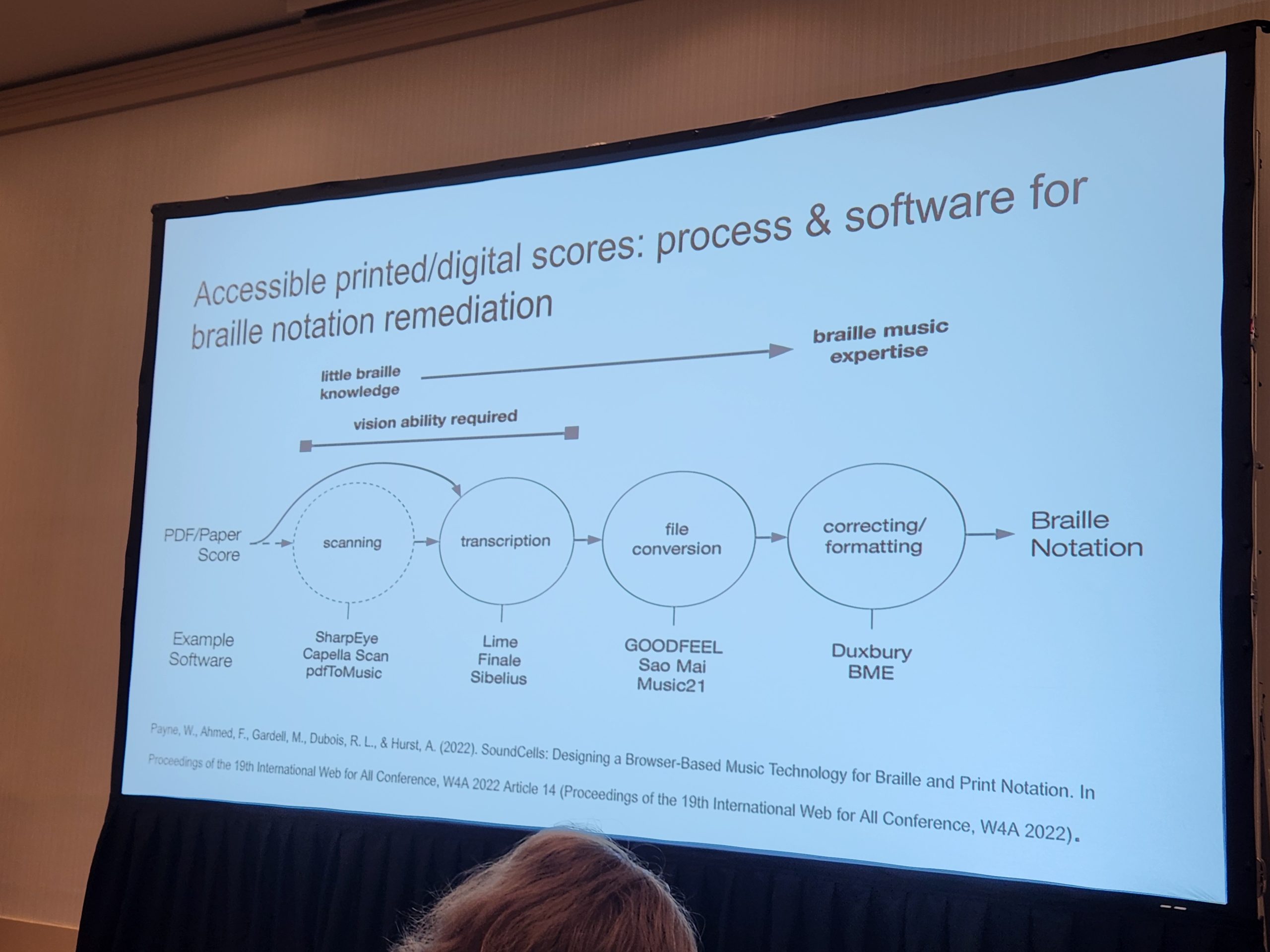
Slides from the presentation “ADA Title II and Music Libraries: Implications, Questions, and Strategies”, Kristi Bergland, Jackie Zook, and Anna Dimoula.

Scholarship, Performance, and Community

The cumulative effect was a sense of shared responsibility, not competition—a model of professional culture grounded in collective advancement, which sharply contrasts with other associations.

One evening event captured that spirit particularly well: Salon Night.

The program featured an eclectic mix of scholarship and performance. There were operatic performances and a playful musical adaptation of Oklahoma! titled Obsolescence, which was hilarious and resonated with our beautiful nerdy hearts. A presentation on queer disco clubs in 1970s New York examined dance floors as spaces of cultural memory and community formation.

Kathleen (Kathy) Abromeit, Head of the Conservatory Library with Oberlin College Libraries, shared work from her new book An Index to Spirituals, , reflecting on how a single reference question in the 1990s grew into decades of scholarly documentation of African American spirituals as both musical and cultural history.

What stood out was not just the diversity of topics but the way people engaged with them.

The room moved easily between laughter, curiosity, and deep reflection—at moments people laughed loudly, and at others they wiped away tears. People spoke about archives, music, and cultural memory with a level of care that extended beyond professional obligation.

Spaces that blend rigorous inquiry with genuine openness were rare in my experience before this conference. It illustrated that professional cultures built around mentorship and inclusivity can redefine how newcomers join, contribute, and thrive.

Confronting the Field’s History

The conference also made space for conversations that confronted the field’s historical foundations. In a presentation on early twentieth-century music librarianship, Veronica A. Wells examined how collection practices helped codify the Western canon in American libraries and ongoing questions regarding designation of “popular” music and the deeply racist, classicist cultural assumptions held by founding librarians.

Those decisions continue to shape music collections today, underscoring how professional cultures can reinforce or challenge exclusion—making intentionality in mentorship and inclusion all the more crucial.

Listening to that presentation, I found myself thinking about Audre Lorde’s essay The Master’s Tools Will Never Dismantle the Master’s House. Lorde reminds us that institutions can claim progressive intentions while still reproducing the structures they inherit.

Music libraries—like many cultural institutions—carry those histories.

The conference also included a panel titled “Furthering Contemporary Indigenous Representation and Inclusion in Collections and Programming: Library and Archive Perspectives,” featuring Jeanette Harrison, Allison McClanahan, Erin Fehr, Heidi Aklaseaq Senungetuk, Delbert Anderson, and Laurie Arnold.

The discussion explored how Indigenous musicians, composers, and archivists are reshaping libraries’ approaches to collections, programming, and performance archives. Speakers reflected on the complex musical histories shaped by the U.S. boarding school system, where Indigenous children were forcibly removed from their communities and subjected to assimilationist policies. Within and despite these institutions, students encountered new musical forms and instruments that later influenced emerging musical traditions, including early jazz.

The panel emphasized that these histories must be understood not as products of the institutions themselves, but as examples of Indigenous resilience, adaptation, and cultural continuity. It also underscored the importance of centering Indigenous voices in archival interpretation and programming, ensuring that contemporary collections and performances reflect the perspectives of the communities whose histories they document.

A Profession Built on Conversation

Part of what makes this kind of conversation possible may lie in the nature of the field itself.

Music librarianship is often described as specialized, but in practice, it resists neat disciplinary boundaries. Music moves across formats and cultural contexts—scores, recordings, dance traditions, film, archives, and the ephemeral materials that surround performance.

A question about a score can quickly become a question about performance practice, cultural history, copyright law, or digital preservation.

Supporting this work requires collaboration with performers, composers, archivists, scholars, technologists, and community historians.

In that sense, music librarianship cannot easily operate in silos. The work itself demands conversation.

And perhaps that necessity helps cultivate the intellectual generosity I witnessed throughout the conference.

Carrying the Lessons Forward

Returning to my work at the University of Chicago Library, I have been thinking about what made this experience so meaningful.

Part of it was structural: thoughtful conference design, accessible programming, and mentorship opportunities for first-time attendees.

But much of it was cultural.

The MLA community demonstrated that professional expertise need not be guarded to be respected, and that intellectual rigor can coexist with generosity and care. In a profession often shaped by institutional prestige and credentialed authority, that culture felt quietly radical.

For someone entering a specialized field without a traditional disciplinary pathway—and inheriting a role that has been absent for years—that kind of professional community is not simply helpful.

It is essential.

And in many ways, the message that stayed with me from the conference came down to a single moment.

At the opening session, incoming MLA president Holling Smith-Borne, director of the Wilson Music Library at Vanderbilt University, reflected on their first experience attending an MLA meeting. They shared that when they first attended the conference, they quietly asked themselves, “Should I bring my full self to this space?” Do I belong here?

But they described choosing something different—to challenge that voice of doubt and replace it with another: No. You belong here. No matter who you are.

Listening to that story, I realized that what I had experienced throughout the conference—the mentorship, the intellectual generosity, and the willingness to share expertise—was not accidental.

It was a community intentionally working to make that statement true.


Acknowledgments

I am deeply grateful to the colleagues who welcomed me into the Music Library Association community with generosity and care. Special thanks to Becca Fülöp, Amanda Dubose, Allison McClanahan, Bruce Evans, Ruthann McTyre, Tamar Barzel, Michelle Rivera, Misti Shaw, Sarah Ward, and Greg MacAyeal for mentorship, conversation, and encouragement throughout the conference.

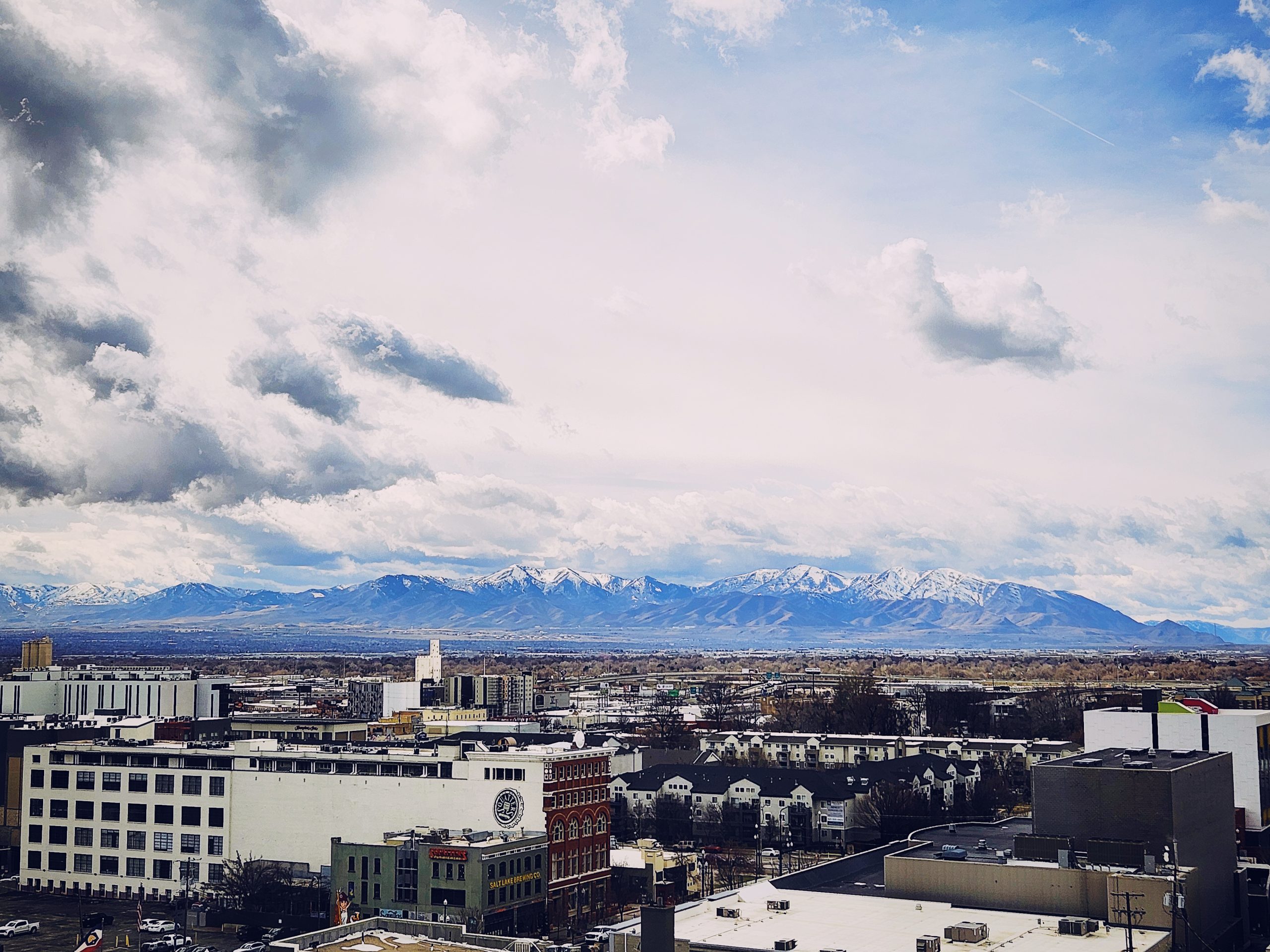
Salt Lake City, Utah.